How long commercial HVAC actually lasts, according to sources you can check
The newer traceable figures cluster around twenty years. ASHRAE data cited by the national laboratory puts the mean lifetime of packaged rooftop units at 21 years; federal rulemaking assumes 21 to 30 years depending on equipment size; and the national laboratory model of the US building stock uses 20 years, with half the equipment still operable at that point. The 15 years usually quoted traces back to ASHRAE's Handbook table, built on a 1976 survey that ASHRAE itself says may be outdated — and the federal survey most people assume measured equipment age does not measure it at all.
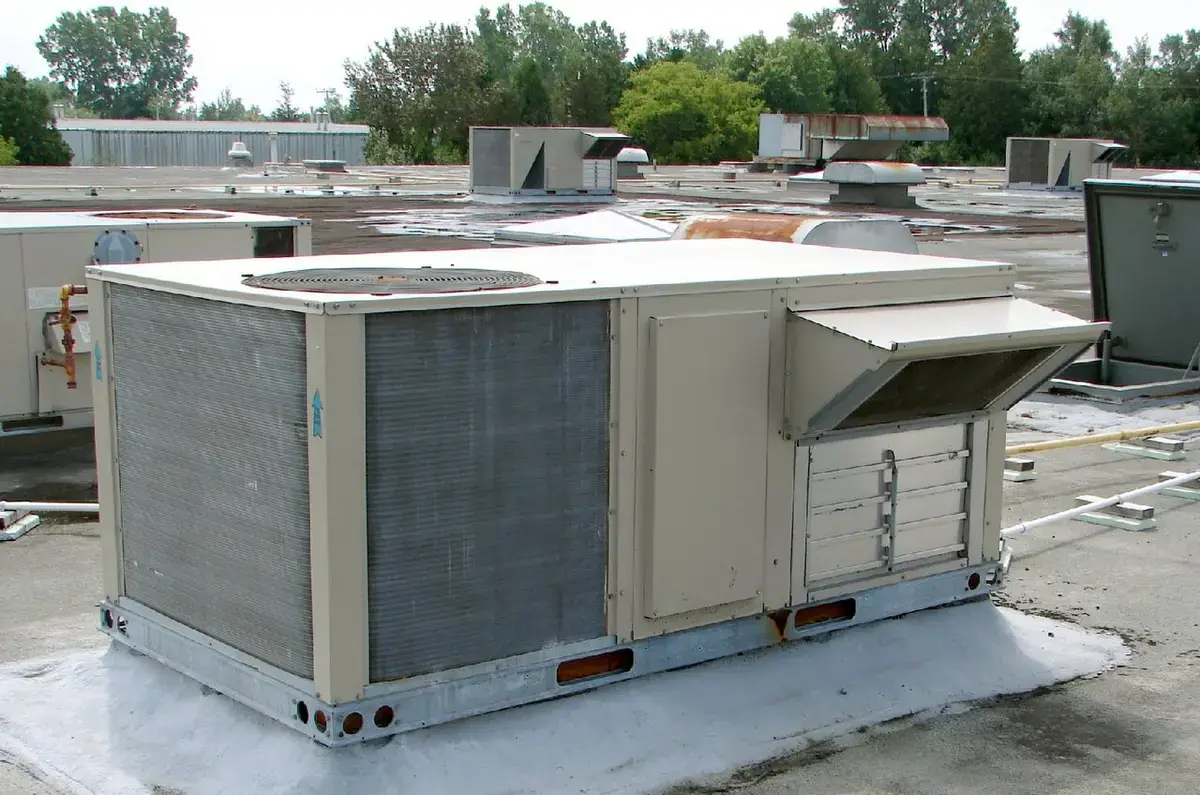
- Rooftop mean
- 21 years
- Federal modeling
- 20–30 years
- Measured age
- Never collected
The short answer, and where each number comes from
Roughly twenty years for packaged rooftop equipment, with boilers running considerably longer. Every figure below is attached to a document you can open.
ASHRAE data covering thirty-three packaged direct-expansion rooftop units gives a mean lifetime of 21 years, as cited in the national laboratory's ComStock documentation. The Department of Energy's 2024 rulemaking on commercial packaged air conditioners assumes an average of 21 years for small equipment, 23 for large and 30 for very large. The national laboratory model used to simulate the entire US commercial building stock assigns HVAC an effective useful life of 20 years, defined so that half the equipment is still operable when it gets there.
Those three sit remarkably close together, and all three are longer than the fifteen-to-twenty-year figure that dominates search results for this question. The 15 comes from the median service-life table in the ASHRAE Handbook, which rests on a survey conducted in 1976; ASHRAE's own footnote warns that data without a newer update may be outdated. Our equipment life expectancy chart puts that table side by side with the federal, New Jersey and Fannie Mae figures.
Commonly quoted online
15–20 yrs
No source given on any page reviewed
ASHRAE Handbook — rooftop units
15 yrs
Median service life from a 1976 survey ASHRAE itself flags as possibly outdated
ASHRAE data, as cited by NREL — rooftop units
21 yrs
Mean lifetime across 33 packaged units
NREL ComStock — HVAC modeling life
20 yrs
Half still operable at this point
DOE — packaged AC, by size class
21–30 yrs
21 small · 23 large · 30 very large
The survey everyone assumes measures this does not measure it
The Commercial Buildings Energy Consumption Survey — the federal survey usually credited for equipment statistics — does not ask how old the HVAC is. It asks one binary question: whether the main heating or cooling equipment has been replaced since the year 2000.
That is the whole extent of it. No year installed, no age band, no vintage. The same is true of the previous survey cycle. Anyone citing that survey for an average equipment age is citing something it never collected.
The confusion has an obvious source: the companion residential survey does collect equipment age, in bands, right up to twenty years and over. Numbers from the residential survey appear to have drifted across into commercial writing, where they describe a different building stock, different equipment and a different duty cycle.
There is one thing the commercial survey does support, because it follows from the binary question. Of the buildings reporting cooling, only around a quarter had replaced their main cooling equipment since 2000 — which puts roughly three-quarters of cooled commercial floor space on main cooling equipment that predated the survey's own reference year by nearly two decades.
Measured age of installed equipment
No federal source exists
The national commercial buildings survey does not ask it. It records only whether the main heating or cooling was replaced since 2000 — a yes or no, with no year and no age.
Assumed life for cost modeling
20 to 30 years
What federal rulemaking and national lab models assume when projecting costs. Defensible to cite, as long as it is described as an assumption rather than a measurement.
Manufacturer and trade estimates
8 to 35 years
The widest and most quoted band, and the least traceable. Ranges vary by an order of magnitude between pages answering the same question.
Why the published answers disagree so violently
Because three different kinds of number are being quoted as though they were interchangeable: assumed lives used in cost models, manufacturer and trade estimates, and a measured age that does not exist.
Search this question and you will find answers spanning eight to thirty-five years, sometimes within a single page. Compressors get quoted at eight to ten years, chillers at twenty to thirty, whole systems at anywhere from twelve to twenty-five. None of the pages currently ranking say where their figure came from, and at least one of them is a residential page answering a commercial question.
The practical consequence is that an owner can be told their plant is at end of life by one source and has a decade left by another, and neither claim is checkable. That is a poor basis for a six-figure capital decision.
For a New Jersey owner, age is the wrong question anyway
The number that decides how much of a replacement gets funded is not the equipment's age. It is whether the equipment is still running on the day you apply for the incentive.
New Jersey's programs measure a saving against a baseline, and the rules set that baseline differently depending on the condition of what is being replaced. Replace equipment that still works and the saving is measured against that equipment. Wait until it fails and the saving is measured against a code-minimum replacement instead — a far narrower gap, and a smaller incentive.
So the intuition that you should run equipment into the ground to extract full value from it is, in New Jersey, expensive. The building keeps paying a higher bill the whole time, and the reward for waiting is a weaker incentive at the end of it.
This is also why the age question generates so much anxiety and so little action. Owners are trying to time a replacement against a number nobody can source, when the decision that actually moves money is a sequencing one.
From the field
Asked for the biggest myth in the business right now:
“Probably that if equipment is still running, there's no reason to replace it. That's one of the biggest misconceptions. A 20-year-old unit can be running every day and still be costing the owner significantly more than a newer, properly sized and controlled system. 'It works' and 'it's operating efficiently' are two completely different things.”
What actually tells you it is time
Condition and cost behavior, both of which are observable in your own records — unlike an age you have to look up.
Rising energy use for the same occupancy and weather is the signal that matters most, because it is exactly the gap an incentive is calculated from. A plant that is quietly consuming more each year is building the case for its own replacement, and the utility will pay in proportion to how large that case has become.
Repair frequency and parts availability follow. So does anything that has already failed and never been fixed — a seized economizer, a control that has been in manual for years, a unit short-cycling through mild weather. These are not signs the equipment is old; they are signs it is wasteful, which is the thing being funded.
None of this requires knowing the manufacture date. Twelve months of utility bills will tell you more about whether a replacement pays than a nameplate will.
From the field
Asked how long equipment really lasts on the jobs they see, as opposed to the brochure number:
“In the real world, you can see boilers and RTUs last 20 to 30 years or even longer, but that doesn't mean they're operating efficiently for all 20 to 30 years. I've seen equipment that technically works but should have been replaced years earlier because of operating costs and repairs. Heat pumps and newer equipment can also last a long time, but maintenance and how hard the equipment is being worked make a big difference.”
Northeast buildings are older than the national average, and heated differently
The Middle Atlantic division has the oldest median building age of any census division in the country — 48 years, against 36 nationally.
That single figure explains a great deal about the New Jersey commercial market. Older buildings hold older plant, and older plant is where the gap between current consumption and achievable consumption is widest.
The Northeast is also the one region of the country where boilers outnumber furnaces in commercial buildings, and where packaged heating units are not the most common heating equipment. Nationally, packaged heating leads boilers by roughly three to one. That inversion is why so much of the retrofit opportunity here is central plant rather than rooftop equipment — and central plant is where the longest published lifetimes and the largest projects both sit.
Common questions
So what number should I actually use?
For packaged rooftop equipment, around 20 to 21 years is the figure you can defend, and it is where federal modeling and the newer ASHRAE data both land; the older ASHRAE Handbook table says 15. Treat it as an assumption used for planning, not as a measurement of your unit. Boilers commonly carry longer published lives, up to about 30 years.
Does an older unit mean a bigger incentive?
Indirectly. The incentive tracks the size of the saving, and older plant usually wastes more, so the gap is wider. But it is the waste that is being paid for, not the age. A well-maintained older unit can model worse than a neglected newer one.
Our equipment is past twenty years and still running. Is that unusual?
No. The twenty-year figure is defined so that around half of equipment is still operating at that point — it is a midpoint, not an expiry date. Plenty of commercial plant runs well beyond it, which is precisely why so much of the New Jersey building stock still has pre-2000 equipment in service.
How do we find out what we actually have?
A survey of the building plus twelve months of electric and gas bills. That establishes both what is installed and how it is performing, which together decide whether a project qualifies and what it would be worth.
Sources
- EIA — Commercial Buildings Energy Consumption Survey microdata codebookThe survey's own question wording. The only equipment-timing questions ask whether main heating or cooling was replaced since 2000 — a binary, with no year installed and no age band.
- EIA — CBECS 2018 Table B2, building characteristics by regionMedian building age by census division: 36 years nationally, 46 in the Northeast, and 48 in the Middle Atlantic — the oldest of any division.
- US Department of Energy — commercial packaged air conditioner standards, 89 FR 44052 (2024)Assumes average equipment lifetimes of 21 years for small, 23 for large and 30 for very large classes, as an input to life-cycle cost analysis rather than as a measurement of installed stock.
- ComStock Reference Documentation — commercial building stock modelAssigns HVAC a 20-year effective useful life, defined so that half of equipment remains operable at that point, and cites ASHRAE data giving a 21-year mean lifetime across 33 packaged rooftop units.
Where this connects across the site
- Equipment life expectancy chartASHRAE, DOE, NJ and Fannie Mae figures side by side
- When to applyWhy replacing while it still works is worth more
- How incentives are calculatedWhy waste, not age, sets the number
- Commercial energy auditsHow condition and usage get established properly
- EconomizersThe failure that raises the bill with no other symptom
- Rooftop unitsThe equipment these lifetime figures describe
- Commercial boilersLongest published lives, largest Northeast opportunity
- MultifamilyWhere old central plant and old buildings overlap
- How a retrofit runsSurvey, model, application, install
Related equipment
- Rooftop unitsPackaged heating and cooling units on commercial roofs, and what replacing an aging one involves.
- BoilersSteam and hot water boilers in apartment and commercial buildings, and when replacing one pays.
- ChillersThe largest single energy load in most buildings that have one.
- Heat pumpsAir-source and water-source heat pumps, including conversions from a boiler and separate cooling.
More guides
- A2L refrigerants and the R-410A phase-outYour existing equipment is not illegal, and you are not required to replace it. What actually changed, and what it means for a planned retrofit.
- HVAC economizersThe most expensive failure in commercial HVAC produces no service call, no complaint and no alarm. It just quietly doubles what cooling costs.
- Commercial energy auditsThe survey and the energy model are not paperwork. The model is what sets your incentive, which is why it comes before any pricing conversation.
- Demand chargesTwo buildings can use identical total electricity and get very different bills. The difference is usually demand.
- Steam vs hot water boilersA great deal of New Jersey's prewar apartment stock still heats with steam. What that means when the plant reaches end of life.
- VRF systemsVariable refrigerant flow is not a premium version of a split system. It solves a specific problem, and in the wrong building it is the wrong answer.
- How incentives are actually calculatedThe incentive is a payment for the energy you stop wasting. That one fact rearranges almost everything owners assume about which projects are worth doing.
- When to apply, and why the order mattersInstalling first is the single most expensive sequencing mistake in New Jersey commercial HVAC. It costs money in three separate ways, and the worst one is invisible.
- NJ energy benchmarkingWhich commercial and apartment buildings must report energy and water use by July 1, what's exempt, and where the numbers come from.
Find out what your building qualifies for
A survey and an energy model tell you the real number. That is a phone call, not a commitment.