Commercial & Multifamily Boiler Replacement in New Jersey
Commercial and multifamily boiler replacement in New Jersey is covered at 50–80% by utility incentives, calculated from the saving against your existing plant. New Jersey's multifamily stock runs on boilers, and a very large share of those were sized for a building that has since been insulated, re-windowed and re-glazed — oversized, atmospheric, and running at seasonal efficiencies far below what a modern condensing plant delivers.
- Typical incentive
- 50–80% of cost
- Common in
- Multifamily, hotels, office
- Biggest win
- Right-sizing an oversized plant
Why is boiler replacement such a strong candidate for incentives?
Because heating is the dominant energy load in a New Jersey multifamily building, and the gap between a 1980s atmospheric boiler and a modern condensing plant is enormous — which is exactly what utility incentive programs are designed to pay for.
Incentives are calculated from projected energy savings. The larger the gap between what the building uses now and what it would use after, the larger the incentive. An oversized, non-condensing boiler serving a large residential load produces one of the widest gaps available in this state.
That is why boiler projects frequently land at the upper end of the incentive range rather than the lower end.
From the field
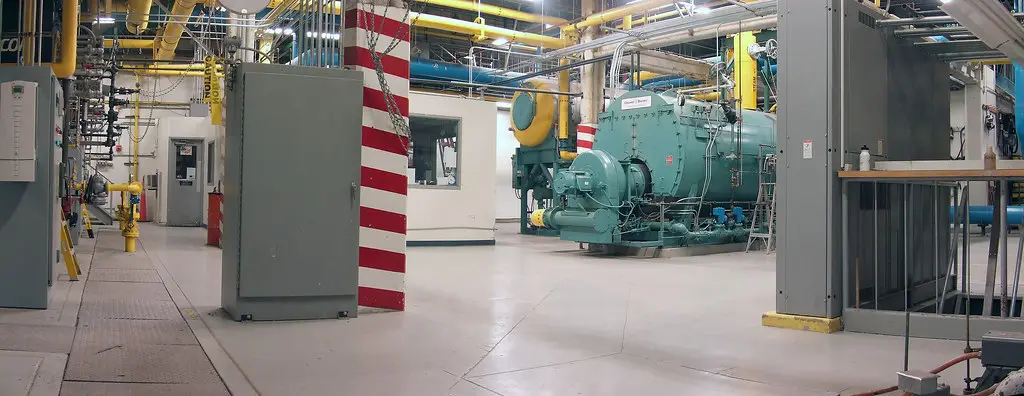
On what a boiler room looks like by the time a replacement is on the table:
“A lot of times when you actually get into the boiler room, you find things that aren't obvious from the outside — old piping, outdated controls, insulation that's missing or falling apart, and equipment that has basically been kept alive through years of repairs.”
What does 'oversized' actually cost a building?
An oversized boiler short-cycles: it fires, satisfies the loop quickly, shuts down, and repeats. Every one of those cycles wastes fuel on purge and standby loss, and it wears the equipment out faster.
Most older plants were sized by rule of thumb, then rounded up for safety. Decades later the envelope has been improved and the load is smaller still. It is common to find a plant with meaningfully more capacity than the building has ever needed.
Modular condensing plants solve this differently: several smaller boilers that stage on as the load rises, so the plant is almost always running near its efficient operating point rather than slamming on and off.
From the field
On why the replacement is not sized from the old nameplate:
“You can't just look at the boiler size and replace it with the same size boiler. The piping, controls, radiation, venting, and how the building actually operates all matter. Oversizing a boiler can create its own problems.”
Can you replace a boiler in an occupied apartment building?
Yes, and it is the normal case. Projects are scheduled outside the heating season wherever possible, and where they cannot be, temporary heat is planned into the job.
The sequencing question that matters most in an occupied building is the domestic hot water, not the space heating — residents notice hot water immediately. That is planned around explicitly rather than discovered on the day.
| Typical existing plant | What replaces it | |
|---|---|---|
| Configuration | One or two large atmospheric boilers | Modular condensing boilers that stage |
| Part-load behavior | Short-cycles on mild days | Modulates down to match the load |
| Venting | Masonry chimney | Sealed direct venting |
| Controls | Fixed setpoint | Outdoor reset, staged sequencing |
| Sizing basis | Rule of thumb, rounded up | Calculated from actual building load |
Common questions
Do you do steam systems?
Steam is common in older New Jersey multifamily buildings and we assess it case by case — the retrofit path differs substantially from a hot-water system.
Will residents lose heat during the work?
No. Projects are scheduled out of season where possible, and temporary heat is planned into the job where it is not.
Do you handle the incentive paperwork?
Yes. The application, the energy modeling and the utility coordination are ours to run.
Find out what your building qualifies for
A survey and an energy model tell you the real number. That is a phone call, not a commitment.