Replacing a gas boiler in New Jersey: electric boiler vs heat pumps, and what the utilities pay
An electric boiler vs heat pump decision for a New Jersey commercial or multifamily building comes down to two numbers: how much heat each delivers per kilowatt-hour, and what the utility pays. An electric resistance boiler converts electricity to heat at close to 100%, with no combustion losses, but no New Jersey electric utility publishes an incentive for one. An air-source heat pump can deliver up to three times more heat than the electricity it uses, and JCP&L, Atlantic City Electric and Rockland Electric pay $2,500 to $6,480 per ton through their building decarbonization programs when it replaces a gas boiler. Rivet Energy surveys the plant and the electrical service, models the saving the utility will accept, and files for pre-approval before any equipment is bought. Licensed partner contractors install.
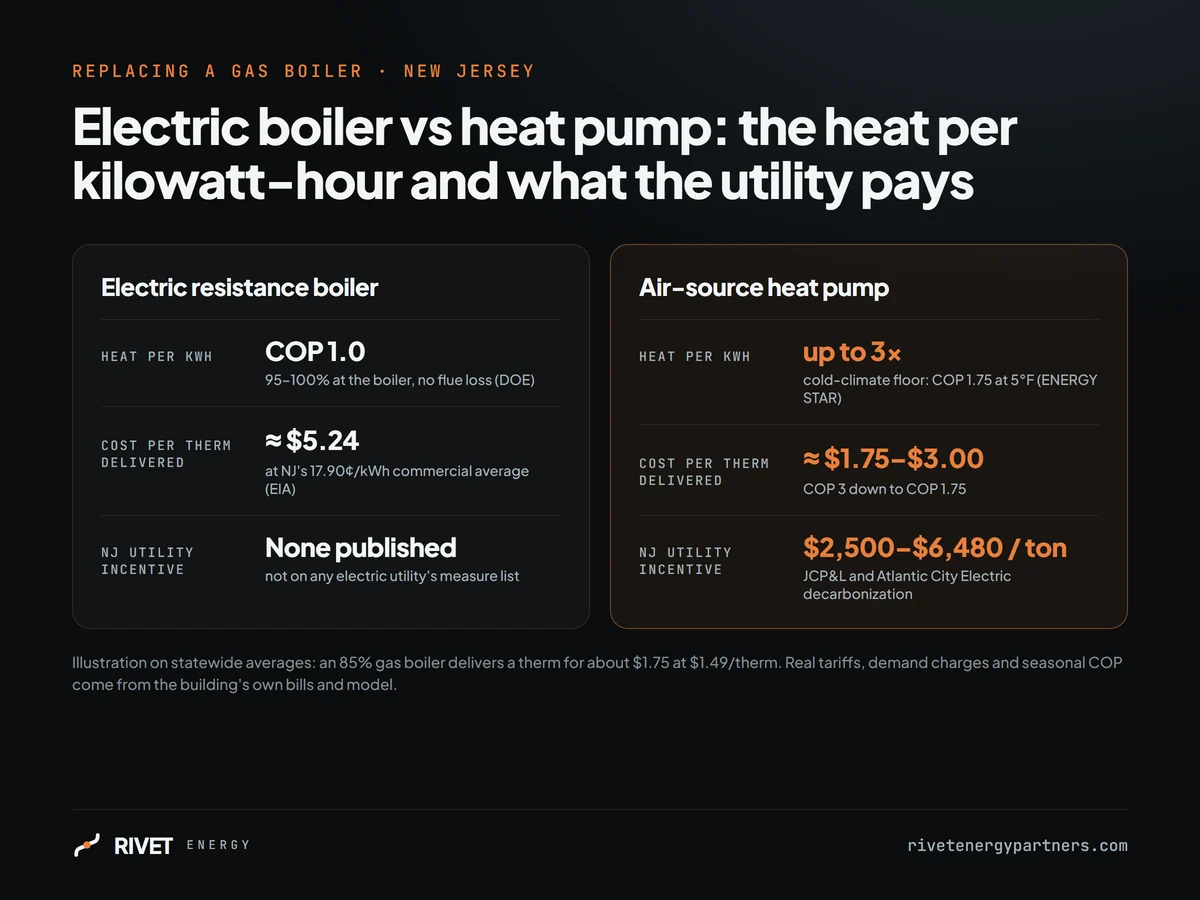
- Electric boiler incentive
- None published
- Heat pump, JCP&L
- $2,800–$5,500 per ton
- Cold-climate floor
- COP 1.75 at 5°F
What an electric boiler does, and what it earns
An electric resistance boiler heats water with no combustion, so the U.S. Department of Energy rates all-electric resistance furnaces and boilers at 95 to 100% AFUE, and New Jersey's Technical Reference Manual assigns electric resistance heat a coefficient of performance of 1.0: one unit of heat for every unit of electricity.
The appeal is simple. An electric boiler keeps the building's existing hot-water distribution, radiators and piping, needs no flue or gas line, and sends no heat up a chimney. The Department of Energy's HVAC renovation guide puts it plainly: because there is no combustion, no heat loss occurs up the flue.
The catch is the incentive. The JCP&L commercial incentive guide of November 2026, Atlantic City Electric's commercial and multifamily decarbonization pages and PSE&G's business program pages list heat pumps, heat pump water heaters and panel upgrades as eligible electrification measures. None of them lists an electric resistance boiler. PSE&G's approved program plan goes further and treats electric resistance heating as the equipment its heat pump incentives are meant to replace.
So an electric boiler is a capital decision made at full price, with a running cost set by New Jersey's commercial electricity rate. That is the comparison the rest of this guide works through.
What a heat pump does differently
A heat pump moves heat rather than generating it, which is why the Department of Energy says modern air-source heat pumps can cut the electricity used for heating by about 50% compared with resistance heat, and EPA's ENERGY STAR program says an air-source heat pump can deliver up to three times more heat energy than the electrical energy it consumes.
The Department of Energy's figures vary with the comparison: its 2023 article says a 50% reduction compared with electric furnaces and baseboard heaters, its home-upgrades page says approximately 65%, and its 2011 HVAC renovation guide says 30 to 40%. The spread reflects climate and equipment, and all three point the same way.
The efficiency falls as the outdoor air gets colder, which is why the cold-climate designation matters in New Jersey. ENERGY STAR's cold-climate criteria require a coefficient of performance of at least 1.75 at 5°F and at least 70% of the 47°F heating capacity at 5°F. NOAA's engineering weather data for Newark put the 99% design temperature at 14°F and the 99.6% at 10°F for 1973 to 1995, so a cold-climate unit sized to that data has margin left at the design hour.
Below its balance point a heat pump leans on backup heat, and the utility programs allow that. JCP&L permits a fossil-fuel system retained as backup if integrated controls are installed and the balance point is below 40°F.
Operating cost on New Jersey prices: the arithmetic
On New Jersey's 2026 averages, a therm of delivered heat costs about $1.75 from an 85% gas boiler, about $5.24 from an electric resistance boiler, and between about $1.75 and $3.00 from a heat pump depending on its coefficient of performance, so a heat pump at a COP of 3 matches gas and an electric boiler costs three times as much to run.
The inputs are statewide averages from the U.S. Energy Information Administration: 17.90 cents per kilowatt-hour for New Jersey commercial electricity from January through August 2026, and $15.47 per thousand cubic feet for gas sold to commercial customers in July 2026, which is about $1.49 per therm at EIA's 10.37 therms per thousand cubic feet. One therm is 29.3 kilowatt-hours of heat.
A gas boiler at 85% thermal efficiency, the rate New Jersey's gas utilities require for a non-condensing rebate, delivers 0.85 therm of heat per therm bought, so a therm delivered costs $1.49 divided by 0.85, or about $1.75. An electric resistance boiler at a COP of 1.0 needs 29.3 kilowatt-hours per therm delivered, or about $5.24. A heat pump at ENERGY STAR's cold-climate floor of 1.75 needs 16.7 kilowatt-hours, about $3.00; at a COP of 3, the top of ENERGY STAR's 'up to three times' range, it needs 9.8 kilowatt-hours, about $1.75.
These are illustrations of the formula, not a quote. A building's real tariff includes demand charges that a heat pump can raise in January, and a seasonal COP depends on the equipment and the weather. The survey and the energy model replace the averages with the building's own bills.
What New Jersey's electric utilities pay for a boiler-to-heat-pump conversion
JCP&L's building decarbonization program pays $2,800 per ton for air-source heat pumps, $3,400 for cold-climate models, $3,700 for air-source VRF, $5,000 for water-source heat pumps and $5,500 for ground-source, capped at 75% of project cost, when the equipment replaces a fossil-fuel system; Atlantic City Electric pays $3,250 to $6,480 per ton on multifamily buildings.
JCP&L's November 2026 guide also pays packaged terminal heat pumps and single-package vertical heat pumps $2,800 per ton, heat pump water heaters $2,000 per unit, and electrical panel upgrades at 75% of their cost up to $6,500 per account when installed with a qualifying measure. Projects need pre-approval before equipment is installed, the fossil-fuel system has to be present at the pre-inspection, and AHRI certificates are required, plus NEEP listing for cold-climate units.
Atlantic City Electric's multifamily decarbonization program pays $3,250 per ton for standard air-source heat pumps and ductless mini-splits, $3,600 for cold-climate and water-source units, $3,900 for air-source VRF, $6,480 for ground-source, $5,000 per unit for packaged terminal heat pumps and single-package vertical heat pumps, and $7,500 per project for a panel upgrade, through an approved Building Decarbonization Trade Ally. Its commercial program pays up to $2,500 per ton for standard air-source units, up to $3,000 for cold-climate, up to $3,250 for air-source VRF, and the lesser of $5,000 per unit or 50% of cost for packaged terminal heat pumps.
PSE&G's program plan, approved by the Board of Public Utilities in October 2024, funds a commercial and industrial building decarbonization pathway with prescriptive incentives for ductless mini-splits, VRF, packaged terminal heat pumps and heat pump water heaters, but as of November 2026 PSE&G publishes no commercial rate card for it, so the figure comes from the utility for each project. Rockland Electric's approved plan lists $5,000 to $6,500 per ton for commercial heat pumps, also without a published rate card.
For comparison, the standard prescriptive rebate for the same heat pump is $175 to $300 per ton at PSE&G and $140 to $200 at Atlantic City Electric. The decarbonization rates are roughly ten times larger because the program pays for displacing gas, not for a more efficient version of the same equipment.
The gas side pays nothing for a full conversion, and the heat pump has to replace the boiler
New Jersey Natural Gas's approved plan refers a customer seeking full displacement of gas heating with a heat pump to the electric utility, and JCP&L requires the fossil-fuel system to be replaced and decommissioned, so a conversion is one application, through the electric utility, for equipment that takes over the heating load.
New Jersey's Technical Reference Manual handles fuel switching inside its commercial heat pump measure. For an early replacement, the baseline for the remaining useful life of the existing boiler is the boiler itself, then a code-minimum version of the replaced equipment and fuel for the rest of the measure life. The manual assumes a partial displacement unless the installed unit is a cold-climate heat pump, which may be modeled as full displacement.
That rule is why the cold-climate designation changes the incentive as well as the comfort. A standard heat pump beside a working gas boiler is modeled as taking part of the load; a cold-climate heat pump that replaces it is modeled as taking all of it, and the saving the utility pays on follows.
It is also why the old boiler stays in place until the pre-inspection. Once it is removed, the utility cannot confirm what was displaced, which is the same sequencing rule our guide on applying before you buy describes for every New Jersey program.
Electrical service: what the programs cover and what they don't
JCP&L pays 75% of an electrical upgrade up to $6,500 per account when the contractor documents that the existing service or panel cannot carry the new electrification load, and Atlantic City Electric pays up to $7,500, but neither program states who pays for utility-side service upgrades, so the survey has to settle it before the project is priced.
JCP&L's eligible electrical work includes panel replacement, a service size increase, a meter base upgrade, main breaker replacement, required feeder wiring and required dedicated circuits. Standalone electrical upgrades and future-proofing for equipment not installed in the project are not eligible.
An electric resistance boiler draws far more current than a heat pump delivering the same heat, so the service question is sharper for the boiler. At a COP of 1.0 against 1.75 to 3, the resistance boiler needs roughly two to three times the electrical capacity for the same output, and it earns no panel incentive to offset the upgrade.
When an electric boiler still makes sense
An electric boiler is the right call where the building must keep its existing hydronic distribution at the supply temperatures it was designed for, where space or venting rules out a heat pump plant, or where the heating load is small enough that the running cost difference stays below the capital difference; it is the wrong call wherever a heat pump can carry the load, because the heat pump costs less to run and the utility pays most of its cost.
Older New Jersey hot-water systems were designed for 180°F supply and 160°F return, as our condensing boiler guide explains. Whether a heat pump plant can serve that distribution, or whether radiators and controls need to change with it, is a building-specific question the survey answers before the equipment is chosen.
Where the answer is that the distribution stays as it is and runs hot, an electric boiler keeps the building simple. Where the answer is that it can run cooler, or that through-wall units will replace the central plant, the heat pump route is the one New Jersey's programs are written to fund.
How a conversion runs with Rivet Energy
We survey the boiler plant, the distribution and the electrical service, model the saving against the existing boiler the way the Technical Reference Manual requires, file the electric utility's building decarbonization application for pre-approval, and coordinate licensed partner contractors for the installation after approval.
What we need to start is your latest electric bill, your latest gas bill and access to walk the building. The bills identify the utilities and the account holder the incentive follows; the walk records the boiler's nameplate, age, condition and the electrical service.
No figure in this guide is a quote. Rates change by program year, PSE&G and Rockland Electric have not published commercial decarbonization rate cards, and the utility accepts a modeled saving, not a rate card, on the larger custom projects. We confirm the current figures with the utility for each building.
Common questions
Do New Jersey utilities pay rebates for electric boilers?
No New Jersey electric utility publishes an incentive for an electric resistance boiler. The JCP&L commercial incentive guide, Atlantic City Electric's decarbonization pages and PSE&G's business pages list heat pumps, heat pump water heaters and panel upgrades as the eligible electrification measures.
Is a heat pump cheaper to run than an electric boiler in New Jersey?
Yes. At New Jersey's 2026 average commercial electricity price of 17.90 cents per kilowatt-hour, an electric resistance boiler costs about $5.24 per therm of heat delivered, and a heat pump between about $1.75 and $3.00 depending on its coefficient of performance.
Can we keep the gas boiler as backup?
Under JCP&L's building decarbonization rules, yes, if integrated controls are installed and the balance point is below 40°F. The program still requires pre-approval and the existing fossil-fuel system to be present at the pre-inspection, and New Jersey's Technical Reference Manual models a non-cold-climate heat pump as partial displacement.
How much does JCP&L pay for a heat pump that replaces a gas boiler?
JCP&L pays $2,800 per ton for air-source heat pumps, $3,400 per ton for cold-climate models, $3,700 for air-source VRF, $5,000 for water-source heat pumps and $5,500 for ground-source heat pumps, capped at 75% of project cost, with pre-approval required before equipment is bought.
Does PSE&G have a building decarbonization program for commercial buildings?
PSE&G's program plan approved by the Board of Public Utilities in October 2024 funds a commercial and industrial building decarbonization pathway, but as of November 2026 PSE&G has published no commercial rate card for it. The figure for a PSE&G building comes from the utility for each project.
Sources
- JCP&L: commercial and industrial incentive guide (v23, November 2026), Section 11 Building DecarbonizationPer-ton rates, the 75% cap, pre-approval, the decommissioning and backup rules, and the electrical upgrade terms.
- JCP&L: Building Decarbonization program pageCompleted projects without pre-approval are not eligible; fossil-fuel systems must be present at pre-inspection.
- Atlantic City Electric: multifamily building decarbonization programMultifamily per-ton and per-unit rates, the $7,500 panel upgrade, and the Trade Ally requirement.
- Atlantic City Electric: commercial building decarbonization incentivesCommercial per-ton rates and the lesser-of caps.
- NJ Board of Public Utilities: PSE&G Triennium 2 order (October 2024)The approved commercial building decarbonization pathway and its measures; electric resistance treated as the equipment to replace.
- NJ Board of Public Utilities: Rockland Electric Triennium 2 order (October 2024)Commercial building decarbonization plan rates of $5,000 to $6,500 per ton.
- NJ Board of Public Utilities: New Jersey Natural Gas Triennium 2 order (October 30, 2024)Customers seeking full displacement of gas heating with a heat pump are referred to their electric utility.
- New Jersey Program Year 6 Technical Reference Manual (BPU order of August 12, 2026)Measure 3.5.2 fuel-switching baselines, partial versus full displacement, and COP 1.0 for electric resistance.
- U.S. Department of Energy: Energy Renovations: HVAC (PNNL-20421, August 2011)Electric resistance furnaces and boilers at 95 to 100% AFUE; heat pumps trim heating electricity 30 to 40%.
- U.S. Department of Energy: Pump Up Your Savings with Heat Pumps (May 30, 2023)Modern air-source heat pumps can reduce electricity use by 50% compared with furnaces and baseboard heaters.
- ENERGY STAR: air-source heat pump fact sheet (2023)Up to three times more heat energy than the electrical energy consumed.
- ENERGY STAR: air-source heat pump key product criteriaCold-climate criteria: COP at 5°F of at least 1.75 and at least 70% of 47°F heating capacity at 5°F.
- NOAA: Engineering Weather Data, Newark International Airport (1973 to 1995)Dry-bulb design temperatures of 14°F at 99% and 10°F at 99.6%.
- EIA: Electric Power Monthly, Table 5.6.BNew Jersey commercial electricity at 17.90 cents per kWh, January through August 2026.
- EIA: New Jersey price of natural gas sold to commercial consumers$15.47 per thousand cubic feet in July 2026.
- EIA: natural gas unit conversion1,000 cubic feet equals 10.37 therms.
- PSE&G: 2026 C&I prescriptive incentive rates and requirements (V2.2, effective August 3, 2026)Standard heat pump rates of $175 to $300 per ton, for comparison.
Where this connects across the site
- Commercial HVAC replacement in NJThe conversion as a planned, incentive-funded project
- HVAC rebate application in NJThe pre-approval package we file before the boiler comes out
- Commercial HVAC assessment in NJThe survey of the plant, the distribution and the electrical service
- Condensing vs non-condensing boilersIf the answer is to stay on gas, which boiler, and why the return water decides
- JCP&L commercial HVAC rebatesThe utility with the published decarbonization rate card
- Atlantic City Electric rebatesSouth Jersey's decarbonization rates
- PSE&G commercial HVAC rebatesStandard heat pump rates, and the pathway without a published card
- Apply before you buyWhy the old boiler stays until the pre-inspection
- Commercial HVAC payback in NJHow the incentive and the running cost set the payback
Related equipment
More guides
- Retrofitting heat in older apartment buildingsMost of New Jersey's older apartment stock still heats with a boiler. When that plant reaches the end of its life there are three routes, and each one is paid for differently.
- Condensing vs non-condensing boilersA condensing boiler only beats a non-condensing one when the building returns cool enough water. What the ratings mean, and what New Jersey's gas utilities pay for each.
- A2L refrigerants and the R-410A phase-outYour existing equipment is not illegal, and you are not required to replace it. What actually changed, and what it means for a planned retrofit.
- HVAC economizersThe most expensive failure in commercial HVAC produces no service call, no complaint and no alarm. It just quietly doubles what cooling costs.
- Commercial energy auditsThe survey and the energy model are not paperwork. The model is what sets your incentive, which is why it comes before any pricing conversation.
- Demand chargesTwo buildings can use identical total electricity and get very different bills. The difference is usually demand.
- Steam vs hot water boilersA great deal of New Jersey's prewar apartment stock still heats with steam. What that means when the plant reaches end of life.
- VRF systemsVariable refrigerant flow is not a premium version of a split system. It solves a specific problem, and in the wrong building it is the wrong answer.
- How incentives are actually calculatedThe incentive is a payment for the energy you stop wasting. That one fact rearranges almost everything owners assume about which projects are worth doing.
- When to apply, and why the order mattersInstalling first is the single most expensive sequencing mistake in New Jersey commercial HVAC. It costs money in three separate ways, and the worst one is invisible.
- How long commercial HVAC actually lastsEvery page answering this question gives a different number and none of them say where it came from. The figures that can be traced run longer than the ones being repeated.
- NJ energy benchmarkingWhich commercial and apartment buildings must report energy and water use by July 1, what's exempt, and where the numbers come from.
- NJ energy rebates in 2026The 2026 rates from each New Jersey utility, the bonus offers that end on December 31, the federal deduction that closed in June, and five claims that are still circulating.
- Commercial HVAC payback in NJPayback is the project cost left after the incentive, divided by what the building saves each year. New Jersey's programs are built around that number, and its energy prices shorten it.
Find out what a conversion pays for your building
Send the latest electric and gas bills and we will survey the plant, the distribution and the electrical service before anyone prices equipment.