Commercial Rooftop Unit Replacement in New Jersey
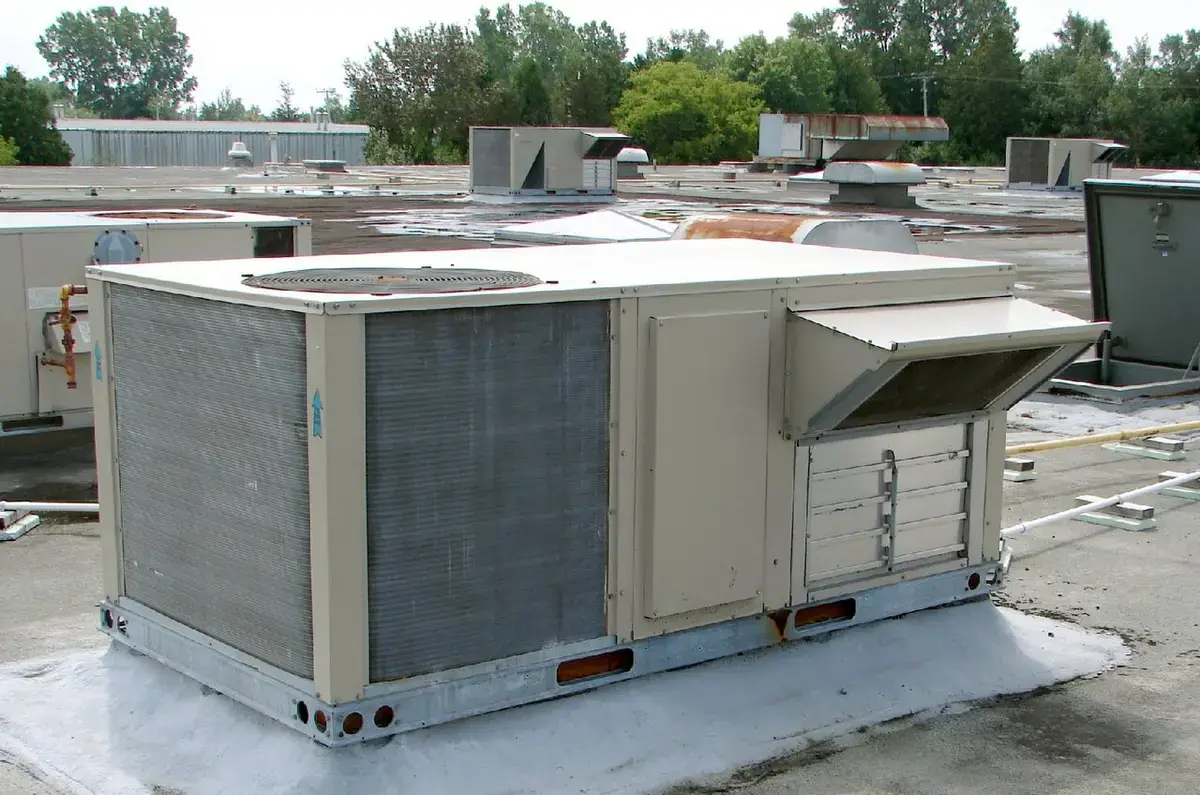
Commercial rooftop unit replacement in New Jersey is covered at 50–80% by utility incentives, sized from the saving against the unit being replaced. A packaged RTU is the workhorse of the state's commercial building stock, and it is also the piece of equipment most likely to be twenty years old, running on failed economizer dampers, and quietly costing a fortune to operate.
- Typical incentive
- 50–80% of cost
- Common in
- Retail, office, warehouse
- Equipment age we target
- 15+ years
When does an RTU make sense to replace rather than repair?
Once a unit is past roughly fifteen years, the economics usually favor replacement — and with incentives covering most of the cost, the crossover point arrives much earlier than building owners expect.
Older packaged units lose efficiency in ways that never show up as a breakdown. Economizer dampers seize shut, so the unit runs mechanical cooling on a mild day when it could be pulling in free outside air. Compressors short-cycle. Belt-driven supply fans drift out of tension. None of that produces a service call; it produces a power bill.
That is the case we build. We are not looking at whether the unit still runs. We are looking at what it costs to run, and whether the incentive available against a replacement closes the gap.
From the field
Asked what they find inside a fifteen-to-twenty-year-old rooftop unit:
“When you open up an older RTU, you usually see a combination of dirty coils, worn belts, old motors, deteriorated electrical components, leaking refrigerant systems, and controls that aren't operating the way they should. One of the things owners don't always realize is how much energy a unit can waste while still technically 'working.' A unit doesn't have to be completely broken to be costing a lot of money.”
What does a rooftop replacement project actually involve?
A survey of the existing units, an energy model showing projected savings, an incentive application through your utility, and then a crane day with a licensed installing contractor.
Curb adapters usually make the physical swap straightforward — a new unit lands on the existing curb rather than requiring roof work. Where the replacement is a different footprint, an adapter is fabricated. Electrical and gas connections are reused where they are sound and replaced where they are not.
Most single-unit changeouts are a one-day crane lift. Multi-unit portfolios are staged so the building is never without conditioning during occupied hours.
From the field
On what a crane day actually depends on:
“A crane day can move pretty quickly when everything is planned correctly. Depending on the equipment and the site, you can swap multiple RTUs in one day. The biggest thing is preparation. If the equipment, crane, rigging, electrical, curb adapters, and crew aren't coordinated, that's when things go sideways.
Replacing four units at once is a completely different operation than doing one. You have to coordinate everything so the crane isn't sitting there waiting and the crew isn't standing around waiting for another part of the job.”
Do the new units have to use a different refrigerant?
Yes. New commercial equipment now ships with A2L refrigerants — typically R-454B or R-32 — following the EPA's phasedown of R-410A under the AIM Act.
This matters for a portfolio decision. You cannot put a new A2L condensing section on an old R-410A indoor coil, so partial replacements are no longer possible in the way they once were. If you are replacing units one at a time across a portfolio, that changes the sequencing.
It is also an argument for moving sooner rather than later on a fleet of aging units: the parts supply for older equipment tightens as the phasedown progresses.
| Item | What we are checking | Why it matters |
|---|---|---|
| Nameplate age & tonnage | Manufacture date, capacity, efficiency rating | Sets the baseline for the savings model |
| Economizer | Whether dampers still modulate | A seized economizer is pure wasted energy |
| Compressor staging | Single-stage vs multi-stage | Determines part-load performance |
| Curb & roof condition | Whether an adapter is needed | Drives install cost |
| Controls | Standalone thermostat vs BMS | Affects both savings and incentive tier |
| Runtime | Occupied hours and setpoints | Utility incentives are calculated from usage |
Common questions
How many units can you do at once?
Portfolios are normal for us. Multi-unit projects are staged across a roof so occupied space stays conditioned throughout.
Do you service or repair rooftop units?
No. We are an efficiency retrofit company, not a service contractor. We replace equipment; we do not run maintenance or emergency calls.
Who performs the installation?
Licensed installing contractors we work with. We manage the project, the energy modeling and the incentive application.
Find out what your building qualifies for
A survey and an energy model tell you the real number. That is a phone call, not a commitment.