How long does it take to pay back a commercial HVAC upgrade in NJ?
How long a commercial HVAC upgrade takes to pay back in New Jersey comes down to one calculation: the cost left after the utility incentive, divided by the energy cost the building saves each year. Incentives that cover 50 to 80% of the cost cut the payback by the same 50 to 80%, and several New Jersey programs go further, buying a project's payback down to as little as two years on custom projects and three under Engineered Solutions. No typical figure applies to your building until its savings are modeled, and the arithmetic below shows what moves the payback.
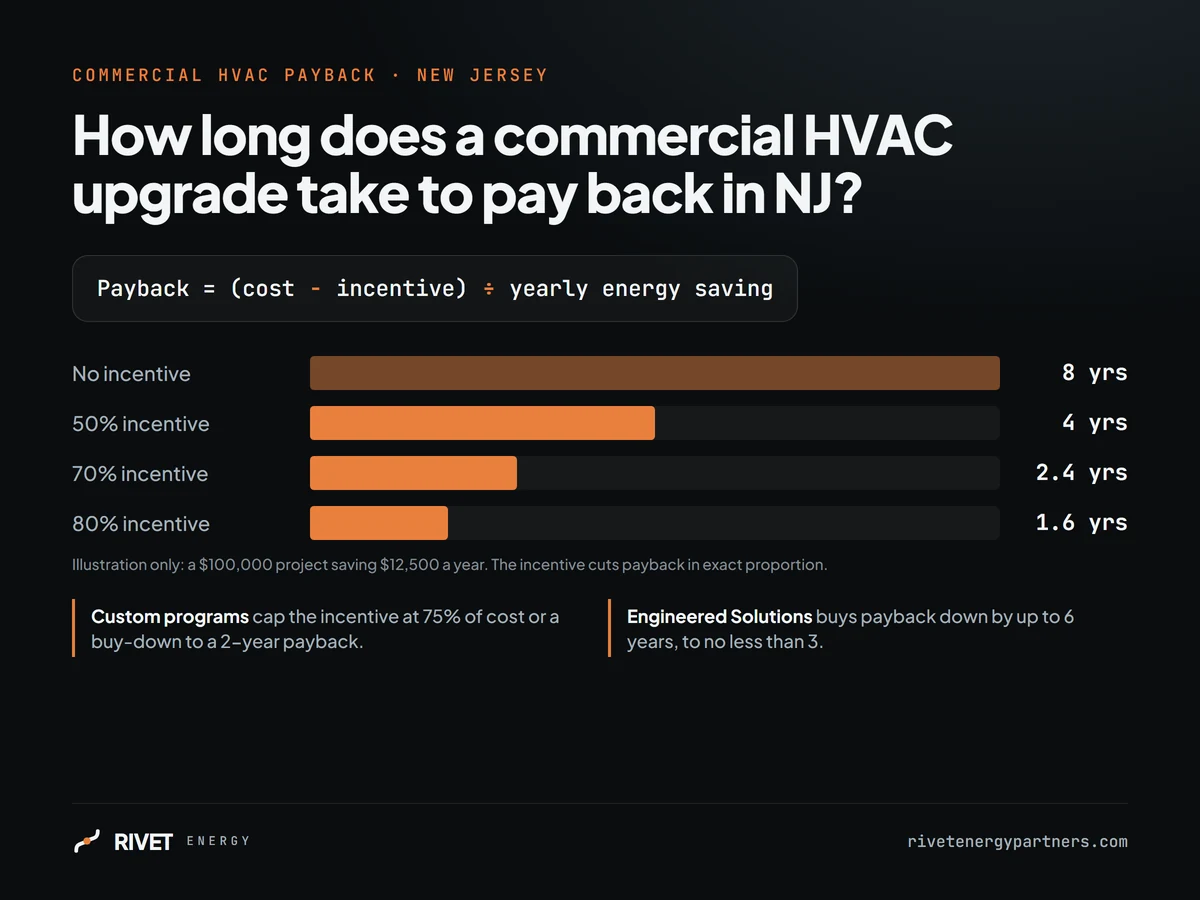
- Payback
- Net cost ÷ yearly saving
- Custom programs, most utilities
- 2-year payback floor
- Engineered Solutions
- 3-year payback floor
How to calculate the payback on a commercial HVAC upgrade
Simple payback is the number of years it takes for the energy cost a new system saves to repay what the project cost you. In New Jersey, the cost that counts is what is left after the utility incentive.
The U.S. Department of Energy defines payback as the years it takes to recover the extra cost of more efficient equipment through lower energy bills. When working equipment is replaced early, the whole installed cost is that extra cost, because nothing would otherwise be spent yet. It adds the test that matters: if the payback is longer than the equipment's life, the extra cost is never recovered.
The payback formula has three inputs: the installed cost, the incentive that comes off it, and the annual energy cost saved. A project costing $100,000 that saves $12,500 a year pays back in 8 years with no incentive. With a 70% incentive, the same project costs $30,000 and pays back in 2.4 years. Those figures are an illustration of the formula, not a quote for any building.
Because the incentive comes straight off the cost, it shortens payback in exact proportion. An incentive covering 50% of project cost halves the payback, 70% cuts it to 30% of the original, and 80% cuts it to a fifth.
New Jersey's energy prices make the same saving pay back faster
New Jersey's commercial electricity price averaged 17.90 cents per kWh from January through August 2026, about 27% above the 14.04-cent national commercial average, so every kilowatt-hour an upgrade saves is worth more here and the payback is shorter.
The U.S. Energy Information Administration puts the average price of electricity to New Jersey's commercial sector at 16.53 cents per kWh for 2025, up from 14.64 cents in 2024, and 17.90 cents for January through August 2026. The national commercial average for the same eight months was 14.04 cents, so New Jersey ran about 27% higher.
Natural gas follows the same pattern. EIA's latest New Jersey price for gas sold to commercial customers is $15.47 per thousand cubic feet for July 2026, about $1.49 per therm at EIA's conversion of 10.37 therms per thousand cubic feet, against a national commercial price of $13.03 per thousand cubic feet for the same month.
These are statewide averages that include delivery and demand charges. EIA's electricity price is total revenue divided by total kilowatt-hours sold, and its New Jersey gas price covers only gas the utilities sell themselves, 32.3% of commercial deliveries in July 2026. A building's real rate depends on its tariff, which is why a payback worth trusting starts from the building's own bills.
New Jersey's programs are written around payback
Several New Jersey utility programs tie the incentive to the project's payback, either by capping it so the payback cannot fall below a set number of years or by setting it by the years it takes off the payback, which makes payback the number the programs themselves are designed around.
Custom projects at Atlantic City Electric, JCP&L, New Jersey Natural Gas, South Jersey Gas and Elizabethtown Gas are capped at the lesser of 75% of project cost or the amount that buys the payback down to two years. New Jersey Natural Gas measures that payback on the customer's cost after the rebate.
Engineered Solutions, the whole-building route for public, nonprofit and multifamily customers among others, works the other way around. Tier 1 pays for the audit in full and then buys the project's simple payback down by up to six years, but not below three. JCP&L notes that this makes the incentive's share of cost depend on the starting payback, peaking at about 67% of project cost for a project that would otherwise take nine years.
The state's Large Energy Users Program, for entities spending $5 million or more a year on energy, uses the same idea: its incentive is the lesser of a per-unit savings rate, 50% of project cost, or the amount that buys the payback down to three years.
Why different starting paybacks can land at the same payback
The payback rules mean projects with different starting paybacks can land at the same payback, because the share of cost the programs pay rises with the starting payback until a program limit is reached: under Engineered Solutions, a seven-year and a nine-year project both land at three years.
Take the Engineered Solutions rule. A project with a nine-year payback has six years bought down and lands at three, an incentive of two-thirds of its cost. A project with a seven-year payback can only be bought down four years before it hits the three-year floor, so its incentive is four-sevenths of the cost, about 57%. A twelve-year project has the full six years bought down and lands at six.
The custom caps work the same way from the other side, but they are ceilings, not payments. A custom incentive is the lesser of a rate per kWh or therm saved, 75% of project cost, or the amount that buys the payback down to two years. A project that would pay back in five years can be bought down to two at most, so its incentive can be no more than three-fifths of the cost, 60%. A project that would pay back in ten years can receive no more than the 75% cap, which would land it at two and a half years. Which limit applies depends on the modeled savings.
These payback examples are arithmetic on the published rules, not a promise about any project. The real figure depends on the modeled savings the utility accepts, which is why we model the building before anyone prices equipment.
Why the old equipment decides how fast the new equipment pays back
On savings-based pathways, replacing equipment that still works can earn a larger incentive, and so a shorter payback, than waiting for it to fail, because for part of the new equipment's life New Jersey measures the saving against the old equipment rather than against a new code-minimum unit.
New Jersey's Technical Reference Manual, adopted by the Board of Public Utilities on August 12, 2026, measures early replacement of working equipment against the existing equipment for its remaining useful life, then against a code or standard-practice unit for the rest of the new equipment's life. Equipment that has already failed is measured against code from the start.
The manual caps that remaining life at one-third of the new equipment's life: 5 years for a rooftop unit, air conditioner or PTAC rated for 15 years, and about 6.7 years for a boiler rated for 20. The early-replacement years are where the larger saving and the larger incentive sit. Once the old unit has been removed it can no longer be shown working, which is the subject of our guide on applying before you buy.
Rooftop units, boilers and PTACs pay back differently
The evidence on payback differs by equipment type: rooftop unit controls retrofits have short paybacks in federal studies, a condensing boiler only reaches its rated efficiency when the heating system returns cool enough water, and heat pumps can cut the electricity used for heating by about half compared with electric resistance heat.
For rooftop units, a Pacific Northwest National Laboratory field test of advanced controllers on 66 units cut their electricity use by 57% on average, with an average simple payback of 2 years at 15 cents per kWh, a lower price than New Jersey's commercial average. The Department of Energy has said a well-implemented rooftop replacement or advanced-controls retrofit can pay back in one to four years, while noting that paybacks vary.
For boilers, ENERGY STAR certified commercial boilers reach at least 94% thermal efficiency, and EPA says they are about 14% more efficient than standard models. But a condensing boiler only reaches that efficiency when return water runs at roughly 80 to 120 degrees Fahrenheit, and many older hot-water systems were designed for 160. In its boiler analysis, the Department of Energy assumed low enough return temperatures for only 5% of replacement boilers in buildings built before 1990. In an older New Jersey building, the heating distribution decides the boiler's payback as much as the boiler does.
For through-wall units, electric resistance heat turns one unit of electricity into one unit of heat, while a standard-size packaged terminal heat pump must deliver at least 2.9 to 3.3 units of heat per unit of electricity at its 47-degree rating point under federal standards. The Department of Energy says heat pumps can cut electricity used for heating by about 50% compared with resistance heat. Rated efficiency describes mild weather, not a New Jersey January, so the modeled saving is lower than the rating suggests.
Payback has to beat the equipment's life
A payback only counts if it is shorter than the equipment will last, and New Jersey's Technical Reference Manual credits most HVAC equipment with a 15-to-25-year life.
The Technical Reference Manual assigns commercial air conditioners, air-source heat pumps, mini-splits and PTACs and PTHPs a 15-year effective useful life, boilers and furnaces 20 years, and ground-source heat pumps 25 years. A rooftop unit that pays back in three years then saves for twelve more.
PTACs are the exception to watch. The Department of Energy's own analysis assumes an average PTAC or PTHP life of 8 years, about half the 15 years New Jersey's manual uses, so a through-wall project should pay back comfortably inside the shorter number.
0% financing turns payback into cash flow
When the cost left after the incentive is financed at 0%, a project whose annual saving is larger than its annual repayment pays for its loan out of the saving, with money left over.
PSE&G lets the customer repay its share of an Engineered Solutions project interest-free on the bill over 60 months, or 120 months for multifamily buildings financed by the New Jersey Housing and Mortgage Finance Agency. New Jersey Natural Gas, South Jersey Gas and Elizabethtown Gas finance 100% of the first $250,000 at 0%, and NEIF lists 0% for JCP&L and Atlantic City Electric customers on projects under $250,000 as of October 2026. FirstEnergy's financing page, last modified March 27, 2026, still lists up to 2.99% for JCP&L commercial customers, so confirm the JCP&L rate before relying on it.
On an illustrative $100,000 project that saves $12,500 a year, the $30,000 left after a 70% incentive, repaid over five years, costs $6,000 a year. Across each year of the loan, the saving beats the repayment by $6,500, before the loan is even paid off. The Board of Public Utilities' staff has recommended keeping these 0% terms into the interim year that runs to June 30, 2028, while encouraging utilities to seek permission to charge interest, so the terms are worth locking in during the current program period.
Common questions
What is a typical payback period for a commercial HVAC upgrade in New Jersey?
There is no reliable typical figure. We found no federal or New Jersey source that publishes a payback on the full cost of replacing working equipment, and the result depends on the old equipment, the building's energy prices and the incentive pathway. New Jersey's custom programs will not buy a project's payback below two years, and Engineered Solutions will not buy it below three.
How do utility incentives change the payback?
In direct proportion. Payback is the cost after the incentive divided by the annual saving, so an incentive covering 70% of project cost cuts the payback to 30% of what it would have been.
Should we wait until the equipment fails?
Waiting can lengthen the payback. New Jersey measures the saving on working equipment against the old unit for part of the new unit's life, and against a code-minimum unit once the old one has failed, so the same project is credited with a smaller saving after a failure and, on savings-based pathways such as custom, a smaller incentive.
Does the federal 179D deduction still shorten payback?
Not for new projects. Section 179D ended for property whose construction begins after June 30, 2026, so a replacement starting now cannot use it to shorten the payback.
Sources
- U.S. Department of Energy: commercial unitary air conditioner standards final rule (May 20, 2024)DOE's definition of payback, and that a payback longer than the equipment's life means the extra cost is not recovered.
- EIA: Electric Power Annual, Table 2.10New Jersey commercial electricity at 16.53 cents per kWh in 2025 and 14.64 cents in 2024.
- EIA: Electric Power Monthly, Table 5.6.BYear-to-date through August 2026: New Jersey commercial 17.90 cents per kWh against 14.04 cents nationally.
- EIA: New Jersey price of natural gas sold to commercial consumers$15.47 per thousand cubic feet in July 2026.
- Atlantic City Electric: C&I Prescriptive and Custom incentive brochure (updated April 8, 2026)Custom incentives capped at the lesser of 75% of project cost or a buy-down to a 2-year payback.
- JCP&L: Engineered SolutionsThe six-year buy-down to no less than three years, and the incentive peaking at about 67% of cost at a nine-year starting payback.
- PSE&G: Engineered Solutions programFree audit, payback bought down by up to six years, and interest-free on-bill repayment over 60 or 120 months.
- New Jersey Natural Gas: Prescriptive and CustomCustom rebates limited so payback, measured on net cost after the rebate, does not fall below two years.
- NJ Clean Energy Program: Large Energy Users ProgramIncentive is the lesser of a savings rate, 50% of project cost, or a buy-down to a 3-year payback.
- New Jersey Program Year 6 Technical Reference Manual (BPU order of August 12, 2026)Early-replacement baselines, the one-third remaining-life cap, and the 15, 20 and 25-year equipment lives.
- Pacific Northwest National Laboratory: advanced rooftop unit control field test (PNNL-22656)57% average reduction in rooftop unit electricity use across 66 units, and a 2-year average payback at 15 cents per kWh.
- ENERGY STAR: commercial boilersAt least 94% thermal efficiency, about 14% more efficient than standard models.
- ENERGY STAR: commercial boiler design guide (May 2020)Condensing boilers need return water of roughly 80 to 120 degrees Fahrenheit; older systems were typically designed for 160.
- U.S. Department of Energy: commercial packaged boiler standards analysis (January 10, 2020)Low return-water temperatures assumed for only 5% of replacement boilers in buildings built before 1990. The rule itself was later vacated.
- U.S. Department of Energy: PTAC and PTHP standards determination (February 13, 2023)An average PTAC and PTHP life of 8 years, and that the efficiency metrics do not measure low-temperature heating.
- NJ Board of Public Utilities: order establishing interim Program Year 7 (July 15, 2026)Staff's recommendation to continue 0% on-bill repayment terms into the year ending June 30, 2028.
- U.S. Department of Energy: Energy Saver guide (2022)Heat pumps can cut electricity used for heating by about 50% compared with electric furnaces or baseboard heaters.
- eCFR: 10 CFR 431.97Federal minimum heating COP for standard-size packaged terminal heat pumps, from 2.9 to 3.3 depending on capacity.
- U.S. Department of Energy: rooftop unit efficiency recognitionA well-implemented rooftop unit replacement or advanced-controls retrofit can pay back in one to four years.
- EIA: Natural Gas Monthly, Table 21U.S. commercial natural gas at $13.03 per thousand cubic feet in July 2026.
- EIA: natural gas unit conversion1,000 cubic feet equals 10.37 therms.
- JCP&L: Custom AdvantageCustom incentives capped at a 2-year simple payback and 75% of project cost.
- South Jersey Gas: prescriptive and custom measuresCustom incentives capped at a 2-year payback and 75% of project cost.
- Elizabethtown Gas: prescriptive and custom measuresCustom incentives capped at a 2-year payback and 75% of project cost.
- New Jersey Natural Gas: Engineered Solutions0% on-bill repayment for 100% of the first $250,000 and 80% of the balance.
- NEIF: JCP&L commercial financing0% financing on projects under $250,000, net of the rebate.
- NEIF: Atlantic City Electric commercial financing0% financing on projects under $250,000, net of the rebate.
Where this connects across the site
- Commercial HVAC unit cost in NJWhat a replacement costs before and after the incentive
- NJ energy rebates in 2026What each utility pays this year, and what ends December 31
- How incentives are calculatedWhy the old equipment sets the number
- Apply before you buyThe sequencing rule that protects the early-replacement baseline
- Commercial HVAC life expectancyHow long the equipment lasts once it has paid back
- Demand chargesThe part of the bill an average price hides
- Commercial HVAC financingThe 0% programs that turn payback into cash flow
- Commercial HVAC assessmentThe survey and energy model behind a real payback figure
- New Jersey commercial energy rebatesWhich utility runs your program, and the 50–80% range
Related equipment
- Rooftop unitsPackaged heating and cooling units on commercial roofs, and what replacing an aging one involves.
- BoilersSteam and hot water boilers in apartment and commercial buildings, and when replacing one pays.
- PTACHotels and older apartment buildings, replaced floor by floor.
- Heat pumpsAir-source and water-source heat pumps, including conversions from a boiler and separate cooling.
More guides
- Retrofitting heat in older apartment buildingsMost of New Jersey's older apartment stock still heats with a boiler. When that plant reaches the end of its life there are three routes, and each one is paid for differently.
- Electric boiler vs heat pumpAn electric boiler burns nothing and earns nothing. A heat pump delivers two to three times the heat per kilowatt-hour and is the equipment New Jersey's electric utilities pay to install in place of gas.
- Condensing vs non-condensing boilersA condensing boiler only beats a non-condensing one when the building returns cool enough water. What the ratings mean, and what New Jersey's gas utilities pay for each.
- A2L refrigerants and the R-410A phase-outYour existing equipment is not illegal, and you are not required to replace it. What actually changed, and what it means for a planned retrofit.
- HVAC economizersThe most expensive failure in commercial HVAC produces no service call, no complaint and no alarm. It just quietly doubles what cooling costs.
- Commercial energy auditsThe survey and the energy model are not paperwork. The model is what sets your incentive, which is why it comes before any pricing conversation.
- Demand chargesTwo buildings can use identical total electricity and get very different bills. The difference is usually demand.
- Steam vs hot water boilersA great deal of New Jersey's prewar apartment stock still heats with steam. What that means when the plant reaches end of life.
- VRF systemsVariable refrigerant flow is not a premium version of a split system. It solves a specific problem, and in the wrong building it is the wrong answer.
- How incentives are actually calculatedThe incentive is a payment for the energy you stop wasting. That one fact rearranges almost everything owners assume about which projects are worth doing.
- When to apply, and why the order mattersInstalling first is the single most expensive sequencing mistake in New Jersey commercial HVAC. It costs money in three separate ways, and the worst one is invisible.
- How long commercial HVAC actually lastsEvery page answering this question gives a different number and none of them say where it came from. The figures that can be traced run longer than the ones being repeated.
- NJ energy benchmarkingWhich commercial and apartment buildings must report energy and water use by July 1, what's exempt, and where the numbers come from.
- NJ energy rebates in 2026The 2026 rates from each New Jersey utility, the bonus offers that end on December 31, the federal deduction that closed in June, and five claims that are still circulating.
Want the real payback for your building?
Send us your latest electric and gas bills. We survey the building, model the saving and the incentive, and give you the net cost and payback before you commit to anything.