NJ HVAC rebates in 2026: commercial rates by utility, the December 31 deadlines and the 179D cutoff
NJ energy rebates in 2026 come from your electric and gas utilities, not the state, and several rates changed this year, including a new PSE&G commercial rate card effective August 3, 2026. PSE&G and JCP&L are running bonus offers that end on December 31, 2026, the federal 179D deduction closed to new projects on June 30, 2026, and the program rules behind every rebate now run to June 30, 2028. This guide sets out what each utility pays today, taken from the utilities' own rate cards, program pages and Board of Public Utilities orders, with the key documents listed at the end.
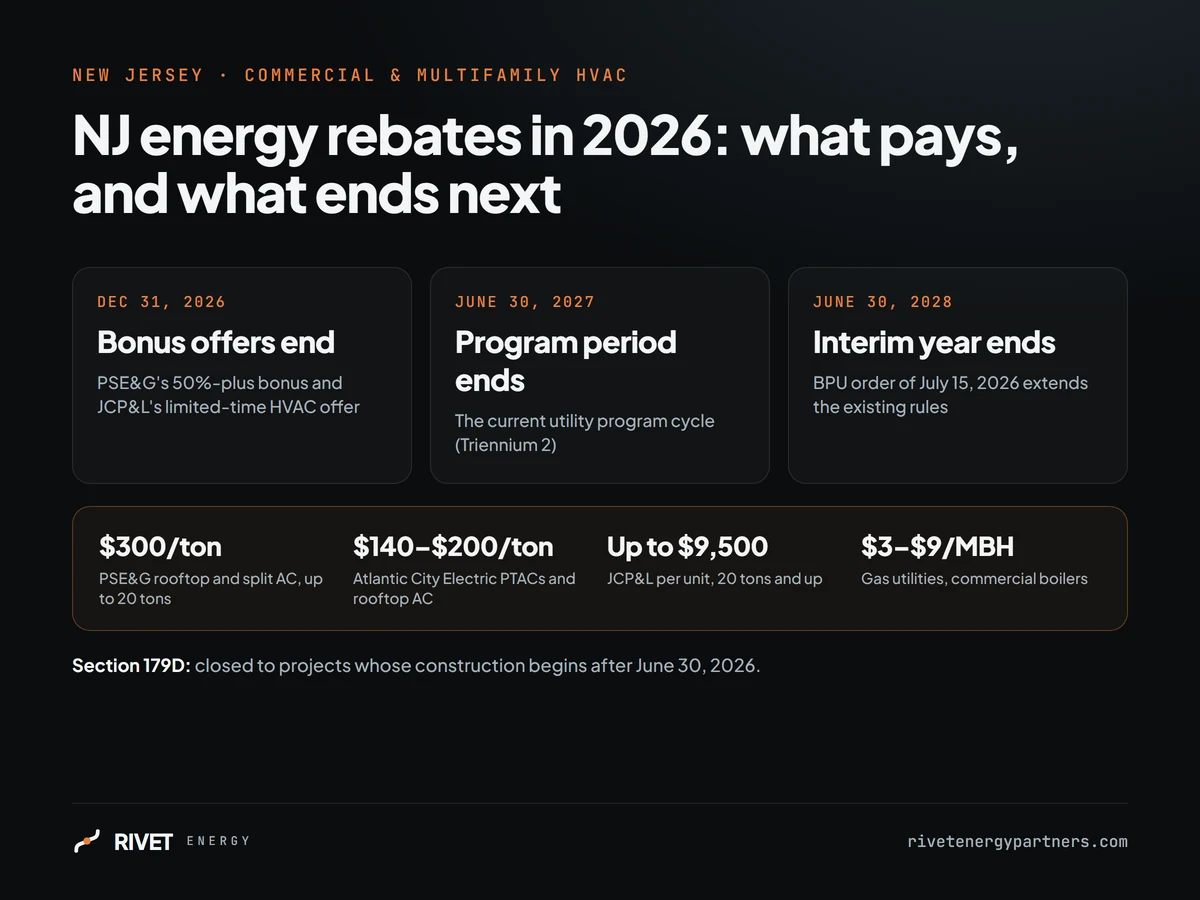
- Bonus offers end
- Dec 31, 2026
- Program rules run to
- June 30, 2028
- Section 179D
- Closed after June 30, 2026
Who pays NJ energy rebates in 2026
New Jersey energy rebates for existing commercial and multifamily buildings are paid by the state's investor-owned utilities in 2026, under rules set by the Board of Public Utilities. The utilities took over most of the NJ Clean Energy Program's efficiency programs for existing buildings starting July 1, 2021.
Seven investor-owned utility companies pay New Jersey's commercial HVAC rebates. The four electric utilities are PSE&G, JCP&L, Atlantic City Electric and Rockland Electric, and the four gas utilities are PSE&G, New Jersey Natural Gas, South Jersey Gas and Elizabethtown Gas. PSE&G appears on both lists.
The NJ Clean Energy Program still administers a short list of programs for the year that started July 1, 2026: New Construction, the Large Energy Users Program, the Local Government Energy Audit, Combined Heat and Power and Fuel Cells (its program page shows it closed), and the solar registration programs. If your building already exists and you are replacing HVAC equipment, your rebate comes from the utility named on your bill.
Most buildings have two utilities, one on the electric bill and one on the gas bill, and they are often different companies. Where both apply to one project, the Board's rules make one of them the lead utility: your single point of contact, which pays the incentive and any on-bill financing and settles the other utility's share behind the scenes.
What PSE&G pays for HVAC equipment in 2026
PSE&G's commercial rate card, effective August 3, 2026, pays $300 per ton for air-cooled rooftop and split air conditioners up to 20 tons and $200 per ton for central DX units above 20 tons, and a separate instant discount at participating distributors applies at the counter.
PSE&G's 2026 rate card also pays air-source heat pumps of 5.4 tons or less $175 per ton at Tier 1 and $300 per ton at Tier 2, and $300 per ton from 5.4 to 20 tons. Ductless mini-split heat pumps earn $250 per ton, water-source heat pumps $300 per ton and ground-source heat pumps $500 per ton.
PSE&G pays through-wall units by the ton as well: $300 per ton for packaged terminal heat pumps and $175 per ton for packaged terminal air conditioners. A packaged terminal heat pump earns $125 more per ton than a PTAC, and a heat pump also replaces the electric resistance heat a typical PTAC uses.
PSE&G also supplies gas, so it pays for boilers too. Condensing hot-water boilers under 300 MBH earn $1,000 per boiler, larger condensing boilers at 88% thermal efficiency earn $4 to $5 per MBH, and ENERGY STAR condensing boilers earn $9 per MBH.
The instant discount and the mail-in rate card are two different channels. The instant list, for the program year July 1, 2026 to June 30, 2027, pays up to $250 per ton at Tier 1 and up to $300 per ton at Tier 2 for units of 5.4 tons or less, applied at the distributor's counter. The rate card pays after the project, on an application.
What JCP&L pays for HVAC equipment in 2026
JCP&L pays rooftop and split air conditioners a capped amount for each size band rather than a rate per ton: up to $1,600 under 5.4 tons, $3,300 from 5.4 to 11.25 tons, $6,000 from 11.25 to 20 tons and $9,500 at 20 tons and up.
JCP&L's caps for units under 20 tons are limited-time amounts that run until December 31, 2026. Before the offer they were $800 or $1,100, $2,300 and $4,000. Only the $9,500 tier is JCP&L's standard rate.
JCP&L's limited-time offer also raises PTACs from up to $200 to up to $250 and packaged terminal heat pumps from up to $250 to up to $375. JCP&L prints those as 'up to' amounts without saying whether they apply per unit or per ton, so treat them as ceilings and confirm the basis with JCP&L before you budget around them.
JCP&L's guide also pays $300 per ton during the offer for single-package vertical units, water-cooled and evaporatively cooled air conditioners, and water-source heat pumps. There is no separate $300 rebate for low- and moderate-income customers, despite what several 2026 guides claim.
What Atlantic City Electric and Rockland Electric pay
Atlantic City Electric pays per ton, in its brochure updated April 8, 2026: $150 or $200 for rooftop air conditioners up to 5.4 tons, $200 from 5.4 to 20 tons, $140 for PTACs and $200 for packaged terminal heat pumps. Rockland Electric's prescriptive program is designed to cover up to 50% of a measure's incremental cost.
Atlantic City Electric pays air-source heat pumps up to 5.4 tons $140 at Tier 1 and $200 at Tier 2, and ductless mini-splits $150 per ton. Its commercial brochure carries no boiler rebate at all; boiler rebates in its territory come from the gas utility.
Atlantic City Electric's multifamily program pays income-eligible buildings more: common-area PTACs earn $140 per ton, or $182 for income-eligible properties, and packaged terminal heat pumps earn $230.75 per ton, or $300 per ton for income-eligible properties.
Rockland Electric serves about 75,000 customers in parts of Bergen, Passaic and Sussex counties. Its commercial prescriptive program is designed to cover up to 50% of the incremental cost of a measure, and its Direct Install program covers up to 80% for businesses with average peak demand under 300 kW. Its published measure list carries no program year and predates the current program period, so we do not quote its per-ton figures.
What the gas utilities pay for boilers
New Jersey's gas utilities pay commercial boiler rebates per MBH of boiler capacity: $4 to $5 per MBH for condensing hot-water boilers at 88% thermal efficiency from 300 MBH up, and $3 to $6 per MBH for non-condensing hot-water boilers. PSE&G, South Jersey Gas and Elizabethtown Gas pay $9 per MBH for ENERGY STAR condensing boilers, from 300 MBH up at the last two.
South Jersey Gas and Elizabethtown Gas publish identical rates for January 1, 2025 through June 30, 2027, and New Jersey Natural Gas matches them on non-condensing boilers and on 88% condensing boilers from 300 MBH up. Steam boilers earn $2 to $3 per MBH. Small condensing boilers under 300 MBH earn $1,000 per boiler at New Jersey Natural Gas and at PSE&G.
South Jersey Gas and Elizabethtown Gas raise prescriptive and custom incentives by 30% for multifamily properties in a low- or moderate-income census tract, an Overburdened Community, an Urban Enterprise Zone or an Opportunity Zone. Both cap prescriptive and custom incentives at $250,000 per utility account per fiscal year.
Two NJ HVAC rebate bonus offers end on December 31, 2026
Two HVAC bonus offers end on December 31, 2026: PSE&G's '50% or more increased incentives' on eligible prescriptive equipment, and JCP&L's limited-time offer on unitary air conditioners, heat pumps, PTACs and PTHPs.
PSE&G's prescriptive program page advertises the bonus on 'eligible equipment' and names no size limit. Some guides say it applies only to systems above 5.4 tons; none of the PSE&G documents we checked, including the rate card and the instant-discount list, says that.
One more offer ends a day earlier: Atlantic City Electric's multifamily Engineered Solutions program is waiving its project service fees for audits, engineering and commissioning on eligible large upgrades through December 30, 2026.
Each offer has its own rule for which date counts, so confirm with the utility whether approval, purchase or installation has to fall before the end date. Approval and installation both take weeks, and equipment bought first and claimed afterward relies on the 90-day lookback, which only the prescriptive pathway allows.
Why every 2026 rebate also has a mid-2027 deadline
New Jersey's utility energy efficiency programs run on a statewide cycle that ends on June 30, 2027, and the Board of Public Utilities has extended the existing rules through an interim year to June 30, 2028.
South Jersey Gas and Elizabethtown Gas require prescriptive and custom applications to be received by June 30, 2027, and New Jersey Natural Gas's offers apply to equipment purchased and installed by the same date.
The Board's order of July 15, 2026 created that interim year, July 1, 2027 to June 30, 2028, on modified versions of the current program plans. Board staff recommended budgets for the interim year of no more than 75% of the current annual budgets. The program rules continue into the interim year, but the interim year's budget may be smaller.
The next full program cycle begins July 1, 2028. Pathway names and rates are likely to change then, which is one more reason the figures on this page carry their dates.
The 179D tax deduction closed to new projects on June 30, 2026
The federal section 179D deduction for energy-efficient commercial buildings does not apply to any property whose construction begins after June 30, 2026, under the One Big Beautiful Bill Act signed on July 4, 2025.
Projects whose construction began on or before June 30, 2026 can still claim the 179D deduction, even if they are placed in service later. For tax years beginning in 2026 the deduction runs from $0.59 to $1.19 per square foot, or $2.97 to $5.94 per square foot where prevailing wage and apprenticeship requirements are met.
Retrofits of existing buildings qualified, including HVAC and hot water work, where the building was placed in service at least five years before the retrofit plan and the savings were certified. A House bill introduced in April 2026 to reverse the change has not moved since it was referred to committee, so a replacement starting now cannot claim 179D.
The section 25C credit that many 2026 rebate guides mention is the energy efficient home improvement credit, not a commercial-building incentive, and it ended for property placed in service after December 31, 2025.
Larger projects are paid on savings, with a payback rule attached
Custom and Engineered Solutions projects in New Jersey are paid on the energy the project is modeled to save rather than a rate per ton, and the programs cap or set that payment using the project's simple payback.
Atlantic City Electric's custom pathway pays $0.30 per estimated annual kWh saved and $3.75 per annual therm, capped at the lesser of 75% of project cost or a buy-down to a 2-year payback. New Jersey Natural Gas, South Jersey Gas and Elizabethtown Gas use the same 2-year payback and 75% caps in their custom programs.
Engineered Solutions Tier 1, offered by the utilities to public, nonprofit and multifamily customers among others, pays for the up-front audit in full and then buys the project's simple payback down by up to six years, to no less than three. At Atlantic City Electric, Tier 2 is capped at 60% of project cost for most customers and 80% for income-eligible multifamily.
Direct Install, for smaller sites, covers up to 80% of project cost for Tier 1 and Tier 2 customers and up to 70% for Tier 3. Entities billed at least $5 million a year in energy costs by New Jersey's investor-owned utilities can use the state's Large Energy Users Program, which pays the lesser of a per-unit savings rate, 50% of project cost or a buy-down to a 3-year payback, with a $100,000 minimum.
Heat pump conversions are paid by the electric utility
When a heat pump replaces gas heating entirely, the incentive to look for is the electric utility's building decarbonization program. New Jersey Natural Gas's approved plan refers customers seeking to replace a gas furnace entirely with a heat pump to their electric utility, and the South Jersey Gas and Elizabethtown Gas program orders describe no commercial gas-side incentive for a full conversion.
New Jersey Natural Gas's approved plan states that a customer seeking full displacement of a gas furnace with a heat pump will be referred to their electric utility. Several 2026 guides claim a fuel switch collects a gas rebate and an electric rebate on the same equipment, and New Jersey Natural Gas's own plan says otherwise. Where a project does have separate gas and electric measures, the Board's lead-utility model files the project once, through one utility.
Building decarbonization programs pay many times the standard per-ton rebates. Atlantic City Electric's multifamily decarbonization program pays $3,250 per ton for standard air-source heat pumps and $5,000 per unit for packaged terminal heat pumps. JCP&L pays $2,800 per ton for air-source heat pumps and $3,400 for cold-climate models, with incentives capped at 75% of project cost and pre-approval required before equipment is bought.
Financing the part the rebate does not cover
New Jersey's utilities offer commercial customers 0% financing for the cost left after the rebate, often repaid on the utility bill itself.
PSE&G's on-bill repayment is interest-free for the current program period, with repayment periods of 5, 7 or 10 years depending on the program. South Jersey Gas and Elizabethtown Gas lend from $2,500 to $250,000 at 100% of project cost, and 80% of any balance above that, for up to 5 years on most programs. New Jersey Natural Gas finances 100% of the first $250,000 and 80% of the balance at 0%.
NEIF, which administers JCP&L's commercial financing, lists 0% on projects under $250,000 as of October 2026, in 3- and 5-year terms or 10 years for multifamily, repaid on the JCP&L bill. JCP&L's January 2026 bill insert also advertises 0%, but FirstEnergy's financing page, last modified March 27, 2026, still lists up to 2.99% for up to 5 years for JCP&L commercial customers, so confirm the rate with JCP&L before you rely on it. FirstEnergy's own New Jersey financing page, last modified March 27, 2026, still lists up to 2.99% interest for up to 5 years, so confirm the rate with JCP&L before you budget around it. JCP&L's guide states that projects claimed through the 90-day lookback are not eligible for its commercial financing, so installing before approval can cost the financing as well as the rebate.
The $25,000 0% on-bill figure quoted in many 2026 guides belongs to the residential programs at PSE&G and New Jersey Natural Gas. It does not apply to commercial buildings.
What an application needs, and when it has to go in
An HVAC rebate application in New Jersey needs a recent utility bill, a W-9 for whoever will be paid, a signed application, and an AHRI certificate and manufacturer spec sheet for each piece of equipment, followed by paid invoices at closeout.
South Jersey Gas and Elizabethtown Gas require pre-approval and an incentive commitment before equipment is purchased. Their pre-approvals last one year, with up to two six-month extensions requested in writing, and a request for missing information has to be answered within 30 days or the application is rejected.
PSE&G, JCP&L and Atlantic City Electric allow prescriptive equipment to be claimed within 90 days of completion. Custom measures at Atlantic City Electric and JCP&L have to be approved before the equipment is bought, and JCP&L's decarbonization program accepts no completed projects without pre-approval.
Common questions
Are NJ energy rebates still available in 2026?
Yes. New Jersey's utilities are paying commercial and multifamily HVAC rebates through the current program period, which ends June 30, 2027, and the Board of Public Utilities has extended the existing rules to June 30, 2028. Some bonus offers end sooner, on December 31, 2026.
Does the NJ Clean Energy Program pay rebates for commercial HVAC?
Mostly not. Since July 1, 2021 the utilities have run the programs for existing commercial and multifamily buildings. The NJ Clean Energy Program still runs New Construction, the Local Government Energy Audit and a few others, plus the Large Energy Users Program, which pays incentives on efficiency projects but only for entities billed at least $5 million a year in energy costs by New Jersey's investor-owned utilities. Per-ton rates attributed to the state program in some 2026 guides come from its closed new-construction schedules.
Can I still claim the 179D deduction on an HVAC replacement in 2026?
Only if construction began on or before June 30, 2026. The 2025 federal tax law ended section 179D for property whose construction begins after that date, so a replacement starting now cannot claim it.
Do gas and electric rebates stack on a heat pump conversion?
Not on the same equipment. A full conversion from gas heating to a heat pump goes through the electric utility's decarbonization program, and New Jersey Natural Gas's approved plan refers customers seeking to replace a gas furnace entirely with a heat pump to their electric utility. Where a project has separate gas and electric measures, one lead utility handles both.
How much of a project do NJ energy rebates cover?
New Jersey utility incentives typically cover 50 to 80% of project cost, most up to 70%, depending on the pathway, the utility and how inefficient the existing equipment is. Per-ton and per-unit rates apply to standard swaps; larger projects are paid on modeled savings with a payback cap.
Sources
- PSE&G: 2026 C&I prescriptive incentive rates and requirements (V2.2, effective August 3, 2026)Per-ton rates for unitary air conditioners, heat pumps, PTACs and PTHPs, and per-MBH rates for boilers. The file name is older than its contents.
- PSE&G: Midstream instant rebate measure list, program year July 1, 2026 to June 30, 2027Up to $250 and $300 per ton for units of 5.4 tons or less, applied at participating distributors.
- PSE&G: Prescriptive programThe '50% or more increased incentives' offer through December 31, 2026, and the 90-day window for recently completed upgrades.
- JCP&L: limited-time offer incentive guide (October 2026)The raised caps for unitary HVAC, PTACs and PTHPs, valid to December 31, 2026.
- JCP&L: commercial and industrial incentive guide (October 2026, v22)Standard caps, application documents, custom pathway caps, decarbonization rates, and the rule that lookback projects lose financing eligibility.
- Atlantic City Electric: C&I Prescriptive and Custom incentive brochure (updated April 8, 2026)Per-ton HVAC rates, the custom pathway's 75% and 2-year payback caps, and the 90-day prescriptive window.
- Atlantic City Electric: multifamily building decarbonization program$3,250 per ton for standard air-source heat pumps and $5,000 per unit for packaged terminal heat pumps.
- South Jersey Gas: commercial application and program terms (June 2026)Boiler rates per MBH, pre-approval rules, the one-year approval term, and the $250,000 per account cap. Elizabethtown Gas publishes the same terms.
- New Jersey Natural Gas: SAVEGREEN business programsCommercial on-bill repayment at 0% on the first $250,000 and 80% of the balance.
- Rockland Electric: incentives for New Jersey business customersThe prescriptive program's design of up to 50% of incremental measure cost.
- NJ Board of Public Utilities: order establishing interim Program Year 7 (July 15, 2026)Extends the current program plans to June 30, 2028, with staff recommending budgets of no more than 75% of current annual budgets.
- NJ Board of Public Utilities: NJCEP compliance filings and budgets, FY27 (June 30, 2026)The five programs the NJ Clean Energy Program still administers.
- IRS: energy efficient commercial buildings deduction (section 179D)Termination for property whose construction begins after June 30, 2026; retrofit eligibility.
- IRS: Revenue Procedure 2025-32The 179D amounts for taxable years beginning in 2026.
- Atlantic City Electric: multifamily prescriptive and custom incentive brochureStandard and income-eligible rates: common-area PTACs $140 or $182 per ton, PTHPs $230.75 or $300 per ton.
- Atlantic City Electric: Engineered Solutions programTier 2 capped at 60% of project cost for most customers and 80% for income-eligible multifamily.
- Atlantic City Electric: multifamily Engineered Solutions program$0 project service fees on eligible large upgrades through December 30, 2026.
- NJ Board of Public Utilities: PSE&G Triennium 2 order (October 30, 2024)Financing at 0% for all of Triennium 2, with repayment periods of 5, 7 or 10 years depending on the program.
- NJ Board of Public Utilities: New Jersey Natural Gas Triennium 2 order (October 30, 2024)Customers seeking full displacement of a gas furnace with a heat pump are referred to their electric utility.
- NJ Board of Public Utilities: Triennium 2 framework order (May 24, 2023)The lead utility pays the incentive and any on-bill repayment and settles the partner utility's share.
- NJ Board of Public Utilities: Atlantic City Electric Triennium 2 order (October 30, 2024)Direct Install tiers at up to 80% and 70% of project cost, and the Engineered Solutions Tier 1 buy-down.
- New Jersey Natural Gas: Prescriptive and CustomOffers apply to qualifying equipment purchased and installed by June 30, 2027.
- New Jersey Natural Gas: Prescriptive and Custom applicationBoiler rate charts, including $1,000 per unit for small condensing boilers.
- South Jersey Gas: on-bill energy efficiency loan program0% from $2,500 to $250,000 at 100% of project cost, 80% of the balance above that, up to 5 years. Elizabethtown Gas publishes the same terms.
- NEIF: JCP&L commercial financing0% financing on projects under $250,000, net of the rebate.
- NEIF: JCP&L commercial brochure3- and 5-year terms, 10 years for multifamily, repaid on the JCP&L bill.
- NJ Clean Energy Program: Large Energy Users ProgramIncentive is the lesser of a savings rate, 50% of project cost, or a buy-down to a 3-year payback, with a $100,000 minimum.
- Congress.gov: H.R. 8477 actionsReferred to the House Ways and Means Committee on April 23, 2026, with no further action.
- Public Law 119-21Section 70505 ends the section 25C credit for property placed in service after December 31, 2025; section 70507 ends 179D for property whose construction begins after June 30, 2026.
Where this connects across the site
- New Jersey commercial energy rebatesThe hub: which utility runs your program, and the 50–80% range
- NJ Clean Energy ProgramThe statewide framework and its pathways: Direct Install, prescriptive, custom and engineered
- PSE&G HVAC rebatesHow PSE&G's commercial and multifamily programs work
- JCP&L rebatesThe shore, the northwest and much of central NJ
- Atlantic City Electric rebatesSouth Jersey and the shore
- NJ Natural Gas rebatesThe gas side of a heating project
- South Jersey Gas rebatesGas-side boiler incentives in the south
- Elizabethtown Gas rebatesGas-side incentives in Union, the northwest and parts of the center
- Commercial HVAC payback in NJHow long an upgrade takes to pay back once the rebate lands
- Apply before you buyWhy the application has to go in before the equipment
- HVAC rebate applicationsWe prepare and file the application for you
- Commercial HVAC financingThe 0% programs that cover what the rebate does not
Related equipment
- Rooftop unitsPackaged heating and cooling units on commercial roofs, and what replacing an aging one involves.
- BoilersSteam and hot water boilers in apartment and commercial buildings, and when replacing one pays.
- Heat pumpsAir-source and water-source heat pumps, including conversions from a boiler and separate cooling.
- PTACHotels and older apartment buildings, replaced floor by floor.
More guides
- Retrofitting heat in older apartment buildingsMost of New Jersey's older apartment stock still heats with a boiler. When that plant reaches the end of its life there are three routes, and each one is paid for differently.
- Electric boiler vs heat pumpAn electric boiler burns nothing and earns nothing. A heat pump delivers two to three times the heat per kilowatt-hour and is the equipment New Jersey's electric utilities pay to install in place of gas.
- Condensing vs non-condensing boilersA condensing boiler only beats a non-condensing one when the building returns cool enough water. What the ratings mean, and what New Jersey's gas utilities pay for each.
- A2L refrigerants and the R-410A phase-outYour existing equipment is not illegal, and you are not required to replace it. What actually changed, and what it means for a planned retrofit.
- HVAC economizersThe most expensive failure in commercial HVAC produces no service call, no complaint and no alarm. It just quietly doubles what cooling costs.
- Commercial energy auditsThe survey and the energy model are not paperwork. The model is what sets your incentive, which is why it comes before any pricing conversation.
- Demand chargesTwo buildings can use identical total electricity and get very different bills. The difference is usually demand.
- Steam vs hot water boilersA great deal of New Jersey's prewar apartment stock still heats with steam. What that means when the plant reaches end of life.
- VRF systemsVariable refrigerant flow is not a premium version of a split system. It solves a specific problem, and in the wrong building it is the wrong answer.
- How incentives are actually calculatedThe incentive is a payment for the energy you stop wasting. That one fact rearranges almost everything owners assume about which projects are worth doing.
- When to apply, and why the order mattersInstalling first is the single most expensive sequencing mistake in New Jersey commercial HVAC. It costs money in three separate ways, and the worst one is invisible.
- How long commercial HVAC actually lastsEvery page answering this question gives a different number and none of them say where it came from. The figures that can be traced run longer than the ones being repeated.
- NJ energy benchmarkingWhich commercial and apartment buildings must report energy and water use by July 1, what's exempt, and where the numbers come from.
- Commercial HVAC payback in NJPayback is the project cost left after the incentive, divided by what the building saves each year. New Jersey's programs are built around that number, and its energy prices shorten it.
Want the 2026 numbers for your building?
We survey the building, model the saving and file the application with your utility, so you know the rebate before you buy anything. Licensed partner contractors do the installation.