Retrofitting heat in older New Jersey apartment buildings: boiler, PTAC or heat pump, and what the utilities pay
Retrofitting heat in an older New Jersey apartment building comes down to three options: a new boiler plant on the existing pipes, a unit-by-unit swap of PTACs for packaged terminal heat pumps, or a conversion of the whole building to heat pumps. In the Middle Atlantic states, 4.5 million homes still heat with steam or hot water, and 30% of apartments in buildings of five or more units run heating equipment that is 20 or more years old. Each route is funded through the utility's multifamily or commercial programs, never the homeowner rebates, and the amount is set by New Jersey's Technical Reference Manual from the equipment actually in the building. Rivet Energy surveys the plant, models the saving the utility will accept, and files for pre-approval before any equipment is bought. Licensed partner contractors install.
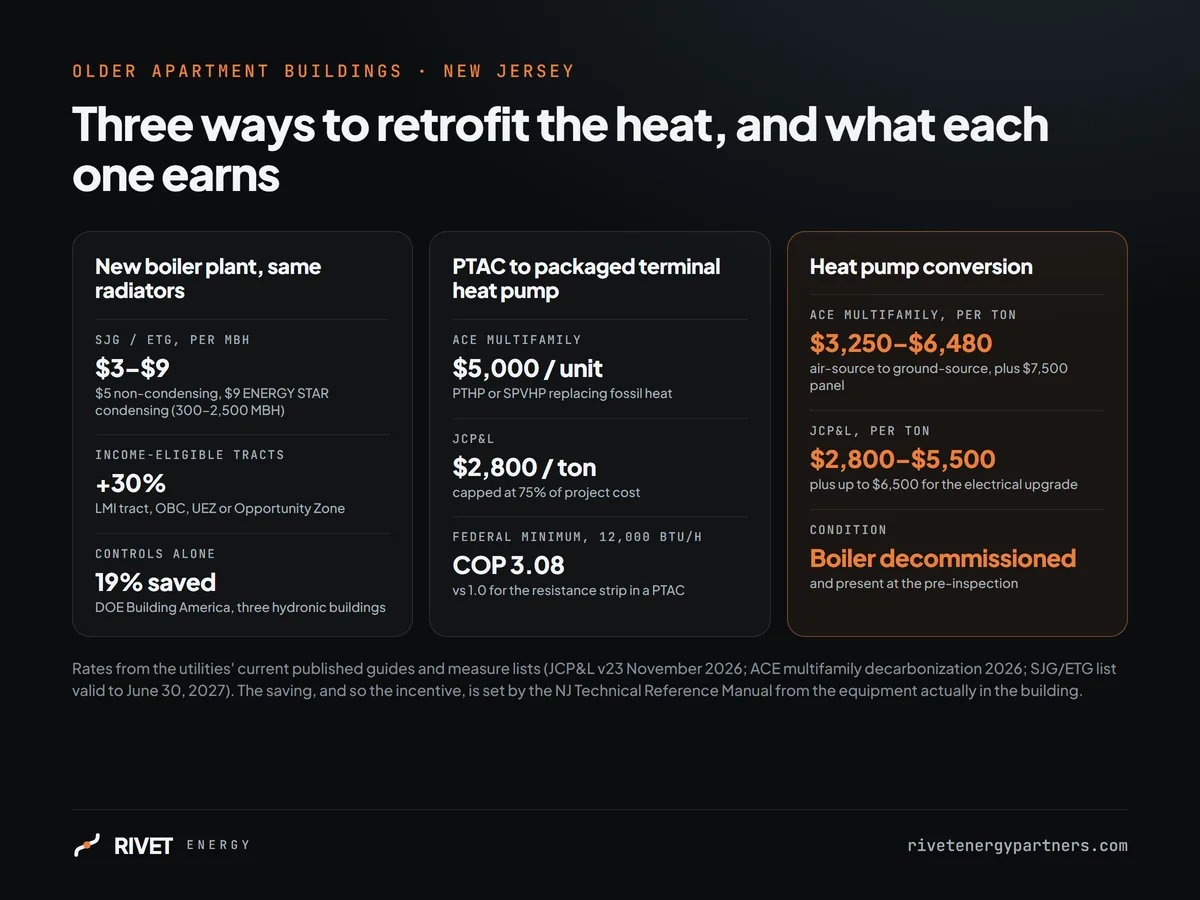
- Boiler plant, SJG / ETG
- $3–$9 per MBH
- PTHP, ACE multifamily
- $5,000 per unit
- Heat pump, per ton
- $2,800–$6,480
Why so much of New Jersey's apartment stock still heats with a boiler
Because boilers last. ASHRAE's equipment-life table gives a cast-iron boiler 35 years on hot water and 30 on steam, and a steel fire-tube boiler 25, so a plant installed when the building was built or last gut-renovated is often still running. The Energy Information Administration's 2020 Residential Energy Consumption Survey counts 4.48 million homes in New York, New Jersey and Pennsylvania heated by a steam or hot water system, 28% of the region's housing, against 7.5% nationally.
The same survey puts 2.8 million apartments in buildings of five or more units on steam or hot water nationally, and finds that 6.91 million of the 22.84 million apartments in those buildings, 30%, have main heating equipment that is 20 or more years old. New Jersey is not broken out separately, but the state sits inside the region where the share is highest.
That age profile is the opportunity. New Jersey's incentive programs pay on the difference between what the building burns now and what it would burn afterward, so a 30-year-old atmospheric boiler feeding radiators in an overheated building is a stronger candidate than a well-specified plant from 2015. The buildings most often written off as too old to bother with are the ones where the arithmetic works best.
Which program an apartment building is in
An apartment building with three or more units is served by its utility's multifamily program, and by the commercial programs for central plant, not by the residential rebates. PSE&G's Multifamily Program addresses structures with three or more units, from garden and mid-rise complexes to mixed-use high-rises; JCP&L's covers residential dwellings with three or more units through high-rise buildings; South Jersey Gas and Elizabethtown Gas set the same three-unit threshold.
New Jersey Natural Gas splits apartment buildings by height. Buildings of three stories or less go through its Multifamily Whole Home Energy Solutions program, which starts with a whole-building audit by a participating contractor; buildings of four stories or more go through Energy Solutions for Multifamily, which pays incentives for specific pieces of equipment. The Technical Reference Manual draws the same line for the whole state: measures in the common areas of buildings over three stories follow the commercial protocol, and measures in low-rise buildings or inside dwelling units follow the residential one. A central boiler in a six-story building is therefore a commercial measure; a PTAC in an apartment is a residential one.
The multifamily programs open with free work. PSE&G, JCP&L, Atlantic City Electric and Rockland Electric all offer a no-cost assessment, and JCP&L and Rockland install basic energy-saving items in units and common areas at no cost. The heating plant is where the money is: JCP&L's multifamily rebates top out at $750 per piece of equipment, so a boiler, a building-wide PTHP swap or a heat pump conversion runs through the commercial prescriptive, custom, engineered or decarbonization pathways described below.
Which utility applies is settled by the bill, not the address. Territory boundaries do not follow town lines, and the top of the latest electric and gas bill is the first thing Rivet asks for.
Option 1: a new boiler plant on the existing distribution
Keeping the radiators and pipes and replacing the boiler is the least disruptive route, and the gas utilities pay for it per MBH of input. On the South Jersey Gas and Elizabethtown Gas measure lists valid through June 30, 2027, a non-condensing hot water boiler earns $6 per MBH under 300 MBH, $5 per MBH from 300 to 2,500 MBH and $3 per MBH above that; a condensing boiler at 88% in the 300 to 2,500 MBH band earns $4; an ENERGY STAR condensing boiler earns $7.50 per MBH under 300 MBH and $9 above it. Non-condensing steam boilers earn $2 to $3 per MBH.
Both gas utilities raise those rates by 30% for multifamily buildings in a low- or moderate-income census tract, an Overburdened Community, an Urban Enterprise Zone or an Opportunity Zone, which covers a large share of the state's older apartment stock. Custom projects on both need pre-approval and are capped at the lesser of 75% of project cost or a buy-down to a two-year payback. New Jersey Natural Gas publishes no rate card for its two multifamily programs; the incentive comes back from a multifamily specialist after the building is enrolled.
The saving the utility credits depends on the baseline. For a boiler from 300 to 2,500 MBH, the Technical Reference Manual's code baseline is 80% thermal efficiency for hot water and 79% for steam, and the 2013 vintage baseline for a natural-draft steam boiler is 77%. A condensing hot water boiler is credited at its rated efficiency, so the rebate follows the rating; the bill follows the return-water temperature, which is why the condensing-vs-non-condensing decision is worked through separately in our boiler guide.
Controls are the cheap half of this option. A U.S. Department of Energy Building America study that replaced boiler controls in three hydronic apartment buildings measured weather-normalized heating savings of 10% to 31%, 19% on average, with outdoor-reset improvements alone saving 10% to 15% at a simple payback under three years. An indoor temperature cutoff cut boiler runtime 28% in the one building that got it, and a nighttime setback of supply-water temperature did nothing measurable. A companion study of 18 steam and hot water apartment buildings in the Northeast found average apartment temperatures of 76.3°F with the energy management system off against a 70°F design point, and put the cost of that overheating at about 18.6% of annual heating spend.
Option 2: PTAC to packaged terminal heat pump, unit by unit
A building that heats and cools each apartment with a through-the-wall PTAC can replace those units with packaged terminal heat pumps one sleeve at a time, and the electric utilities pay per unit or per ton. Atlantic City Electric's multifamily building decarbonization program pays $5,000 per unit for a PTHP or single-package vertical heat pump that replaces fossil-fuel heat; JCP&L's decarbonization program pays $2,800 per ton for the same equipment, capped at 75% of project cost.
The efficiency gain is set by federal law before any incentive applies. Under 10 CFR 431.97, a standard-size PTHP of 7,000 to 15,000 Btu/h must reach a heating COP of 3.7 minus 0.052 times its capacity in thousands of Btu/h: 3.08 for a 12,000 Btu/h unit, meaning three units of heat per unit of electricity, against the 1.0 of the electric resistance strip inside an old PTAC. The same unit's cooling EER must reach 14.0 minus 0.3 times capacity, 10.4 at 12,000 Btu/h, against 9.5 for the largest PTACs.
Where the PTACs are only cooling and the heat comes from a central boiler, the swap is a partial conversion: the Technical Reference Manual models a heat pump that is not cold-climate rated as partial displacement, with the fossil system assumed to carry the load below a 35°F switchover. JCP&L's decarbonization rules allow a retained backup only under integrated controls with a balance point below 30°F, and bar one at 40°F or above, so the plan for the boiler has to be written before the PTHPs are ordered. ASHRAE gives a commercial through-the-wall unit 15 years, and the Technical Reference Manual uses the same 15-year life for PTACs and PTHPs, with a remaining useful life capped at 5 years for early replacement.
Option 3: converting the building to heat pumps
Replacing the boiler with air-source, variable-refrigerant-flow or ground-source heat pumps is the route New Jersey's electric utilities pay most for. Atlantic City Electric's multifamily decarbonization program pays $3,250 per ton for a standard air-source heat pump, $3,600 for a cold-climate model, $3,900 for air-source VRF and $6,480 for ground-source, plus $7,500 per project toward a panel upgrade; JCP&L pays $2,800, $3,400, $3,700 and $5,500 per ton respectively, with up to $6,500 per account for the electrical upgrade and a 75% project cap.
The cold-climate designation decides how the saving is modeled. ENERGY STAR's cold-climate criteria require a coefficient of performance of at least 1.75 at 5°F and at least 70% of the 47°F heating capacity at 5°F, and non-ducted cold-climate units must reach HSPF2 8.5 and SEER2 15.2. The Technical Reference Manual allows the full-displacement calculation, in which the whole gas load disappears, only for cold-climate units; everything else is partial displacement. The U.S. Department of Energy's Energy Saver guide puts the electricity saving of a heat pump at about 50% against resistance heat, and ENERGY STAR describes up to three times more heat than the electricity consumed.
Two rules shape the application. JCP&L requires the fossil-fuel system to be replaced and decommissioned, present at the pre-inspection, and the project pre-approved before equipment is purchased: completed projects without pre-approval are not eligible, and offer letters are valid for 30 days. Atlantic City Electric routes the work through an approved Building Decarbonization Trade Ally and pays in-unit full-displacement cold-climate systems at the lesser of $10,000 or 50% of the cost of the largest system, rising to $12,000 or 60% for moderate-income buildings. PSE&G lists heat pumps among the equipment its multifamily and prescriptive programs cover but publishes no per-ton decarbonization rate, and Rockland Electric's multifamily program is a no-cost direct-install offer for market-rate buildings only.
For a building that is also deciding between an electric boiler and a heat pump, the running-cost arithmetic on New Jersey prices is in our separate guide; the short version is that no electric utility publishes an incentive for an electric resistance boiler.
The early-replacement rule, and why the old boiler stays until the pre-inspection
For equipment that still works, the Technical Reference Manual sets the baseline as the existing equipment for its remaining useful life and a code-compliant unit after that, with the remaining life capped at one-third of the effective useful life: 6.67 years on a 20-year commercial boiler, 5 years on a 15-year heat pump or PTHP. The existing plant therefore has to be shown working, and custom projects need proof that includes a video or picture of it in operation.
Once the boiler is out, that proof cannot be produced and the project is credited against code from day one, which is a smaller saving and a smaller incentive. If the existing efficiency is unknown, the manual substitutes the ASHRAE 90.1 value from when the equipment was new, or the 2013 value if the vintage is unknown; a nameplate photograph and the install year are worth real money.
The timing rules sit on top of that. South Jersey Gas and Elizabethtown Gas require pre-approval to verify equipment eligibility. JCP&L requires pre-approval across its programs and allows a 90-day lookback only for prescriptive work, and projects claimed through the lookback lose its commercial financing. Atlantic City Electric's multifamily program advertises six-month retroactive incentives and $0 project service fees as a limited offer, but its decarbonization pathway still requires documented existing conditions before the fossil system comes out. The sequence that protects the incentive is the same on every route: survey, latest bills, energy model, application and pre-inspection, then the equipment order.
Income-eligible and affordable buildings earn more
Every New Jersey utility pays more for affordable or income-eligible multifamily buildings. Atlantic City Electric's Engineered Solutions program covers up to 80% of project cost for income-eligible multifamily customers against up to 60% for most customers; JCP&L caps custom incentives for income-eligible multifamily buildings at 80% of project cost instead of 75%; South Jersey Gas and Elizabethtown Gas add 30% to their prescriptive rates; PSE&G extends on-bill repayment to 120 months for multifamily buildings financed by the New Jersey Housing and Mortgage Finance Agency, against 60 months otherwise.
JCP&L's criteria are an affordable housing designation (NJHMFA, LIHTC, HUD, a public housing authority, or Section 8, 202 or 811), a low- or moderate-income census tract, an Overburdened Community, an Opportunity Zone or an Urban Enterprise Zone, or residents enrolled in a state income program. The gas utilities use the tract and zone tests. A rent-regulated building qualifies on the same terms as any other; the incentive follows the building's energy performance and location, not its rent structure.
The state is also preparing an income-qualified multifamily program of its own, M-RISE, funded under the Inflation Reduction Act and still at the pre-application stage with no published incentive amounts. Until it opens, the utility programs are the funding.
What a defensible retrofit plan looks like
A plan the utility will approve starts with the building's own records: the boiler nameplate, age and a photograph of it running, the PTAC or heat pump inventory, the latest electric and gas bills for every meter, and the heights and unit counts that put the building in the right program. From those, the energy model sets the saving, the saving sets the incentive, and the application goes in before anything is ordered.
Rivet Energy does that side of the project for apartment buildings across New Jersey: the survey, the model, the application to each utility and the coordination through pre-inspection, installation and closeout. Licensed partner contractors carry out the installation, and on a Direct Install or trade-ally pathway the utility's participating contractor does. Residents stay in place; central plant replacement is scheduled outside the heating season, and in-unit work runs floor by floor with notice.
If the building is over 25,000 square feet and in property tax class 4C, the same bills feed the annual benchmarking report due each July 1, which our benchmarking guide covers.
Common questions
Does an apartment building use the residential or the commercial rebates in New Jersey?
Neither as a homeowner would. Buildings with three or more units enroll in the utility's multifamily program, and central plant such as a boiler or a building-wide heat pump conversion is paid through the commercial prescriptive, custom, engineered or decarbonization pathways. The Technical Reference Manual treats common-area measures in buildings over three stories as commercial and in-unit measures as residential.
Which heating retrofit earns the largest incentive for an older apartment building?
A heat pump conversion that replaces and decommissions the gas boiler: $3,250 to $6,480 per ton at Atlantic City Electric and $2,800 to $5,500 per ton at JCP&L, plus a panel upgrade allowance. A PTAC-to-PTHP swap earns $5,000 per unit at Atlantic City Electric. A new gas boiler earns $3 to $9 per MBH at South Jersey Gas and Elizabethtown Gas, 30% more in income-eligible tracts.
Can we keep the radiators and still get an incentive?
Yes. A new hot water or steam boiler on the existing distribution is a prescriptive measure at the gas utilities, and boiler controls are a measure in their own right. The Building America study of hydronic apartment buildings measured an average 19% heating saving from controls alone.
Why does the old boiler have to stay in until the utility inspects it?
Because the incentive is calculated against the equipment actually in the building for its remaining useful life, and custom projects need proof the old plant works, including a video or picture of it running. Remove it first and the saving is measured against a code-compliant boiler instead, which is smaller.
Do residents have to move out during the retrofit?
No. Central plant replacement is planned capital work in an occupied building and is normally scheduled outside the heating season; in-unit PTHP or heat pump work is sequenced floor by floor with notice to residents.
Sources
- EIA: 2020 Residential Energy Consumption Survey, Table HC6.1, space heating by housing unit typeSteam or hot water heat in 2.80 million apartments in buildings of five or more units; 6.91 million of 22.84 million such apartments with heating equipment 20 or more years old.
- EIA: 2020 Residential Energy Consumption Survey, Table HC6.7, Northeast and Midwest4.48 million of 16.04 million Middle Atlantic homes on steam or hot water.
- ASHRAE Handbook, HVAC Applications, equipment service life table (supplemental file)Cast-iron boilers 35 years hot water and 30 steam, steel fire-tube 25, commercial through-the-wall units and air-to-air heat pumps 15.
- New Jersey Program Year 6 Technical Reference Manual (BPU order of August 12, 2026)Multifamily protocol split at three stories, boiler and PTAC baselines, measure lives, the early-replacement rule, and partial versus full displacement for heat pumps.
- U.S. DOE Building America: Hydronic Heating Retrofits for Low-Rise Multifamily Buildings (September 2014)Heating savings of 10% to 31%, 19% on average, from boiler control replacement; outdoor reset 10% to 15%; temperature cutoff 28% of runtime.
- U.S. DOE Building America: Overheating in Hot Water- and Steam-Heated Multifamily Buildings (October 2013)Average apartment temperatures of 76.3°F with energy management systems off and the 18.6% cost of overheating.
- 10 CFR 431.97: energy conservation standards for packaged terminal air conditioners and heat pumpsPTHP COP = 3.7 − 0.052 × capacity and EER = 14.0 − 0.3 × capacity for standard-size units of 7,000 to 15,000 Btu/h.
- ENERGY STAR: Heat Pump Version 6.2 specification (February 2, 2026)Cold-climate criteria: COP at 5°F of at least 1.75, at least 70% of 47°F capacity at 5°F, HSPF2 8.5 and SEER2 15.2 for non-ducted units.
- U.S. Department of Energy: Energy Saver Guide (2022)Heat pumps reduce electricity use for heating by approximately 50% compared with resistance heat.
- ENERGY STAR: air-source heat pumpsUp to three times more heat energy than the electrical energy consumed.
- PSE&G: Multifamily ProgramThree or more units; on-bill repayment, rebates and incentives for HVAC; no-cost assessments.
- PSE&G: Engineered SolutionsMultifamily apartments eligible; cost share buys down simple payback by up to six years; 120-month repayment for NJHMFA-financed multifamily.
- New Jersey Natural Gas: SAVEGREEN multifamily programsMultifamily Whole Home Energy Solutions for three stories or less; Energy Solutions for Multifamily for four stories or more.
- South Jersey Gas: prescriptive and custom measure list (January 1, 2025 to June 30, 2027)Boiler rates per MBH, the 30% multifamily uplift, and the custom pathway caps. Elizabethtown Gas publishes the same list.
- South Jersey Gas: Multifamily ProgramThree or more units; enhanced incentives for affordable housing.
- Atlantic City Electric: multifamily building decarbonization programPer-ton, per-unit and panel rates, the custom $330 per MMBtu rate, the in-unit caps, and the Trade Ally requirement.
- Atlantic City Electric: Engineered Solutions programUp to 60% of project cost for most customers and up to 80% for income-eligible multifamily.
- Atlantic City Electric: Multifamily ProgramSix-month retroactive incentives and $0 project service fees as a limited offer.
- JCP&L: Multifamily ProgramThree or more units; no-cost assessment and direct install; up to $750 per piece of equipment.
- JCP&L: commercial and industrial incentive guide (v23, November 2026)Decarbonization per-ton rates, the 75% cap, pre-approval and decommissioning rules, backup balance points, and the 80% cap for income-eligible multifamily custom projects.
- Rockland Electric: Home Energy Assessment for Multi-FamilyNo-cost assessment and direct install for market-rate properties with three or more units.
- NJ Clean Energy Program: utility-run programs for businessesThe state's list of each utility's multifamily and building decarbonization programs.
- NJ Clean Energy Program: M-RISEThe state-run, IRA-funded income-qualified multifamily program, at the pre-application stage.
Where this connects across the site
- Multifamily HVAC retrofits in NJThe building type, the programs and what we do for apartment owners
- Commercial HVAC replacement in NJThe retrofit as a planned, incentive-funded project
- HVAC rebate application in NJThe pre-approval package we file before the boiler comes out
- Commercial HVAC assessment in NJThe survey and energy model that set the incentive
- Steam vs hot water boilersWhy so much prewar stock runs on steam, and what replacement looks like
- Condensing vs non-condensing boilersWhich boiler, and why the return water decides
- Electric boiler vs heat pumpThe running-cost arithmetic and the incentives paid only for heat pumps
- Apply before you buyEach utility's pre-approval and lookback rules
- Atlantic City Electric rebatesThe utility with the largest multifamily decarbonization rates
- JCP&L commercial HVAC rebatesDecarbonization rates and the income-eligible rules
- South Jersey Gas rebatesBoiler rates per MBH
- NJ energy benchmarkingClass 4C apartment buildings over 25,000 square feet report each July 1
Related equipment
- BoilersSteam and hot water boilers in apartment and commercial buildings, and when replacing one pays.
- PTACHotels and older apartment buildings, replaced floor by floor.
- Heat pumpsAir-source and water-source heat pumps, including conversions from a boiler and separate cooling.
- Mini-splitsFor the very large share of NJ buildings that never had a duct in them.
More guides
- Electric boiler vs heat pumpAn electric boiler burns nothing and earns nothing. A heat pump delivers two to three times the heat per kilowatt-hour and is the equipment New Jersey's electric utilities pay to install in place of gas.
- Condensing vs non-condensing boilersA condensing boiler only beats a non-condensing one when the building returns cool enough water. What the ratings mean, and what New Jersey's gas utilities pay for each.
- A2L refrigerants and the R-410A phase-outYour existing equipment is not illegal, and you are not required to replace it. What actually changed, and what it means for a planned retrofit.
- HVAC economizersThe most expensive failure in commercial HVAC produces no service call, no complaint and no alarm. It just quietly doubles what cooling costs.
- Commercial energy auditsThe survey and the energy model are not paperwork. The model is what sets your incentive, which is why it comes before any pricing conversation.
- Demand chargesTwo buildings can use identical total electricity and get very different bills. The difference is usually demand.
- Steam vs hot water boilersA great deal of New Jersey's prewar apartment stock still heats with steam. What that means when the plant reaches end of life.
- VRF systemsVariable refrigerant flow is not a premium version of a split system. It solves a specific problem, and in the wrong building it is the wrong answer.
- How incentives are actually calculatedThe incentive is a payment for the energy you stop wasting. That one fact rearranges almost everything owners assume about which projects are worth doing.
- When to apply, and why the order mattersInstalling first is the single most expensive sequencing mistake in New Jersey commercial HVAC. It costs money in three separate ways, and the worst one is invisible.
- How long commercial HVAC actually lastsEvery page answering this question gives a different number and none of them say where it came from. The figures that can be traced run longer than the ones being repeated.
- NJ energy benchmarkingWhich commercial and apartment buildings must report energy and water use by July 1, what's exempt, and where the numbers come from.
- NJ energy rebates in 2026The 2026 rates from each New Jersey utility, the bonus offers that end on December 31, the federal deduction that closed in June, and five claims that are still circulating.
- Commercial HVAC payback in NJPayback is the project cost left after the incentive, divided by what the building saves each year. New Jersey's programs are built around that number, and its energy prices shorten it.
Find out what your apartment building's heating retrofit pays
Send the latest electric and gas bills and the building's unit count and we will survey the plant, model the saving and file with each utility before anyone prices equipment.