Condensing vs non-condensing boilers in commercial buildings: efficiency, return water and NJ rebates
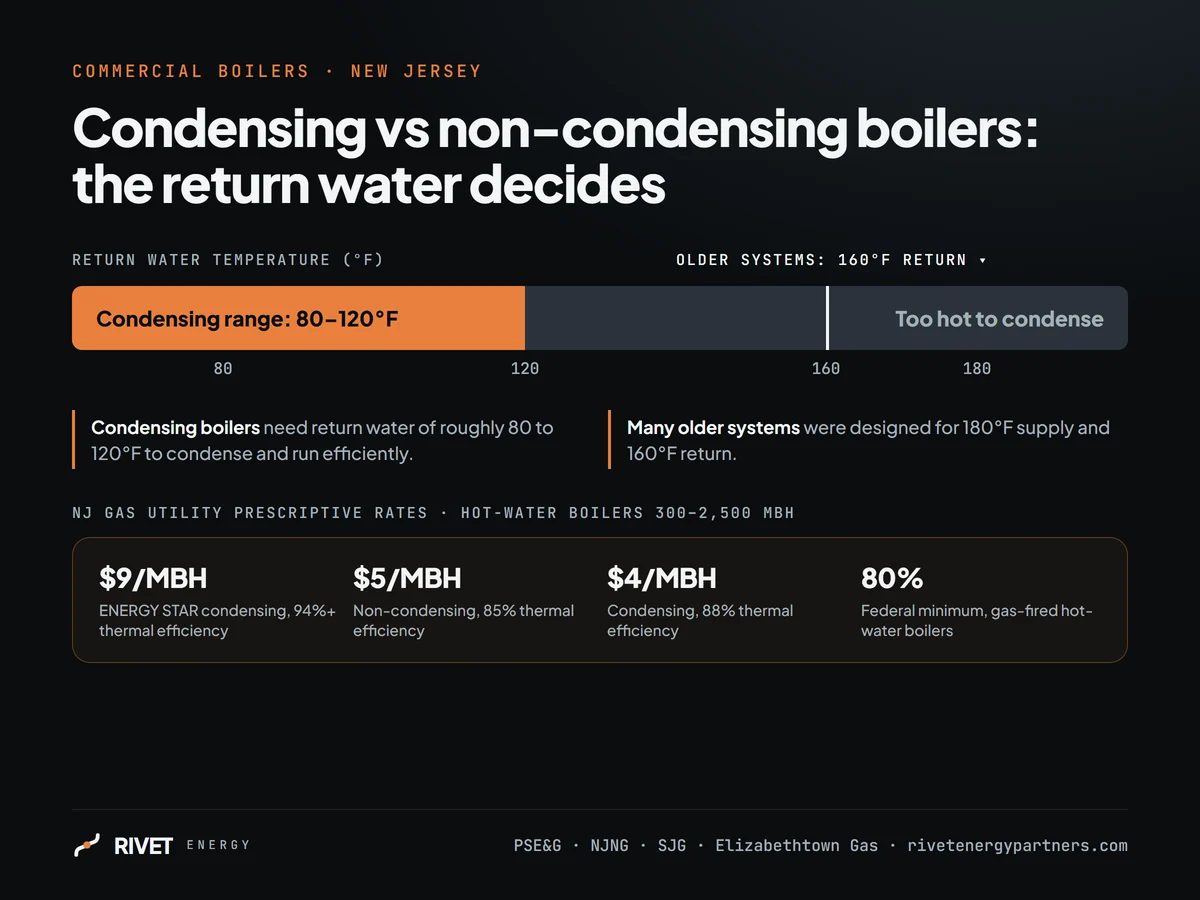
The difference between condensing and non-condensing boilers is what happens to the heat in the exhaust: a condensing boiler cools its flue gas until the water vapor in it condenses, and recovers heat that a non-condensing boiler sends up the chimney. That is worth at least 94% thermal efficiency on an ENERGY STAR commercial boiler, against a federal minimum of 80% for a gas-fired hot-water boiler. A condensing boiler only condenses when the heating system returns water at roughly 80 to 120°F, and many older buildings were designed to return it at 160°F. Rivet Energy checks the return water before a boiler is chosen, and files the gas utility's incentive, which pays $9 per MBH for an ENERGY STAR condensing boiler. Licensed partner contractors do the installation.
- Condensing range
- 80–120°F return
- ENERGY STAR boilers
- ≥ 94% efficient
- NJ rebate, ENERGY STAR
- $9 per MBH
What is the difference between a condensing and a non-condensing boiler?
A condensing boiler extracts extra heat by cooling its flue gas far enough for the water vapor in it to condense, while a non-condensing boiler keeps its flue gas hot to stop that acidic condensate from forming inside the boiler and chimney.
ENERGY STAR's commercial boiler design guide explains that before condensing boilers existed, hot-water systems were typically designed to a 160°F return temperature to prevent corrosive acidic condensate from forming. A non-condensing boiler is built around that rule, so the heat carried by the water vapor in its exhaust leaves through the flue.
A condensing boiler is built to handle the condensate instead. ENERGY STAR's guide describes cooler exhaust gases leaving through a PVC flue and producing an acidic condensate drip. That is why a condensing boiler vents and drains differently from the atmospheric boiler it replaces, and why the venting belongs in the replacement scope.
The federal minimum for a gas-fired hot-water commercial boiler from 300,000 to 2,500,000 Btu per hour is 80% thermal efficiency, and 82% combustion efficiency above that size, under 10 CFR 431.87. ENERGY STAR certified condensing boilers must reach at least 94% thermal efficiency.
A condensing boiler only condenses with cool return water
A commercial condensing boiler needs return water of typically 80 to 120°F to condense its flue gas and run efficiently, according to ENERGY STAR, and a condensing boiler fed hotter return water loses the efficiency advantage it was bought for.
ENERGY STAR's guide states the consequence plainly: if a new condensing boiler is installed but the building keeps operating at the higher return temperatures designed for older boilers, the flue gas will not condense and the efficiency advantage is lost.
The same guide quotes one industry expert's estimate that 90% of commercial condensing boilers never operate in the condensing range. That figure is a third-party estimate rather than a measured statistic, but it explains why the boiler's nameplate efficiency and the building's fuel bill can disagree.
Condensing boilers also run more efficiently at low fire than at high fire, according to ENERGY STAR. That is why ENERGY STAR requires a turndown ratio of at least 5 to 1, so a boiler rated at 1 million Btu per hour can run as low as 200,000 Btu per hour instead of cycling on and off.
Why many older buildings return water too hot to condense
Many older hot-water systems were designed for 180°F supply and 160°F return, with radiators and baseboard sized for 140 to 200°F water, so a condensing boiler dropped into an unchanged older system often never sees return water cool enough to condense.
ENERGY STAR notes that emitters designed to operate between 140 and 200°F do not allow a condensing boiler to operate efficiently. In its 2020 analysis of commercial boilers, the U.S. Department of Energy assumed low enough return temperatures for only 5% of replacement boilers in buildings built before 1990.
Return water is often hotter than the design because of how the system is piped. ENERGY STAR warns that a bypass valve sending supply water straight back to the boiler return greatly raises the return temperature and takes the boiler out of the condensing range.
The fixes are mostly controls and distribution, not the boiler. Outdoor air reset lowers the supply temperature in milder weather, which lowers the return temperature and lets the boiler condense more of the season. ENERGY STAR also points to retrofitting high-performance panel radiators or fin-tube baseboard, and to low-temperature emitters that can meet the load at 120°F supply water.
What 80%, 85%, 88% and 94% boiler efficiency mean
For gas-fired hot-water commercial boilers, 80% thermal efficiency is the federal minimum, 85% is the efficiency New Jersey's gas utilities require for a non-condensing boiler rebate, 88% is their condensing tier, and 94% is the ENERGY STAR threshold.
The federal 80% minimum has applied to gas-fired hot-water boilers from 300,000 to 2,500,000 Btu per hour since March 2, 2012. The Department of Energy's January 10, 2020 rule would have raised it to 84% from January 10, 2023, but the U.S. Court of Appeals for the D.C. Circuit vacated that rule on July 7, 2023, and the 2012 standards were restored.
ENERGY STAR's commercial boiler specification covers boilers from 300,000 to 2,500,000 Btu per hour, requires at least 94% thermal efficiency and a 5-to-1 turndown, and EPA says certified boilers are 14% more efficient than standard models. When EPA developed the specification, it identified a clear distinction between condensing and non-condensing boilers at 92% thermal efficiency.
A rated efficiency is measured under test conditions. Whether a condensing boiler delivers its rating in a building depends on the return water temperature, which is why the rating is the start of the comparison, not the answer.
What New Jersey's gas utilities pay for condensing and non-condensing boilers
For hot-water boilers from 300 to 2,500 MBH, PSE&G, New Jersey Natural Gas, South Jersey Gas and Elizabethtown Gas pay $9 per MBH for an ENERGY STAR condensing boiler, $5 per MBH for a non-condensing boiler at 85% thermal efficiency, and $4 per MBH for a condensing boiler at 88%.
The rate cards put an 88% condensing boiler below an 85% non-condensing one in that size band. On a 1,000 MBH boiler, the prescriptive rebate works out to $9,000 for an ENERGY STAR condensing model, $5,000 for an 85% non-condensing model and $4,000 for an 88% condensing model. That arithmetic is from the published rates, not a quote for any project.
Above 2,500 MBH, condensing boilers at 88% earn $5 per MBH and non-condensing hot-water boilers earn $3 per MBH. Under 300 MBH, a small condensing boiler earns $1,000 per boiler at PSE&G and New Jersey Natural Gas. Steam boilers earn $2 to $3 per MBH. South Jersey Gas and Elizabethtown Gas publish identical rates for January 1, 2025 through June 30, 2027.
Atlantic City Electric's commercial brochure carries no boiler rebate, so in its territory the boiler incentive comes from the gas utility. South Jersey Gas and Elizabethtown Gas raise prescriptive and custom incentives by 30% for multifamily properties in a low- or moderate-income census tract, an Overburdened Community, an Urban Enterprise Zone or an Opportunity Zone.
Prescriptive rates are one route. On custom and Engineered Solutions projects the incentive follows the modeled saving instead, which is where a boiler that actually condenses, in a building whose controls have been fixed, shows its value.
Rebates follow the rating; the fuel bill follows the return water
New Jersey's Technical Reference Manual, which the utility programs use to count savings, calculates a replacement boiler's gas savings from its rated efficiency against a code baseline of 80% for gas hot-water boilers, and it sets its adjustment factor for a condensing boiler running in non-condensing mode to 1.0, so the deemed saving assumes the boiler performs at its rating.
The Program Year 6 manual, adopted by the Board of Public Utilities on August 12, 2026 and in use from October 1, 2026, takes the baseline from ASHRAE 90.1-2019: 80% thermal efficiency for gas hot-water boilers from 300 to 2,500 kBtu per hour, 82% combustion efficiency above that, and 79% for gas steam boilers. For an early replacement, it uses the existing boiler's efficiency where known.
Because the manual's condensing adjustment is set to 1.0, a condensing boiler that never condenses is credited the same deemed saving as one that does. The building's real fuel saving is not. That gap is the owner's risk, and it is closed by checking the return water before the boiler is chosen.
The manual also limits its boiler reset control measure to cut-out controls on non-condensing boilers, because reset savings are minimal for them, while both reset and cut-out controls apply to condensing boilers. Reset is worth more on a condensing boiler because a lower supply temperature is what lets it condense.
Steam boilers and condensing efficiency
Steam boilers sit in a lower efficiency range than hot-water boilers: the Department of Energy's 2020 analysis studied efficiency levels up to 83 to 87% for steam classes against 97 to 99% for hot-water classes, and New Jersey's gas utilities pay steam boilers $2 to $3 per MBH.
The federal minimum for a gas-fired steam boiler is 79% thermal efficiency, and New Jersey's Technical Reference Manual uses 79% as the code baseline for gas steam boilers.
For a steam building, the condensing question is really a question about converting the distribution to hot water, which is a building-specific decision covered in our guide to steam and hot-water boilers.
When a non-condensing boiler, or both, is the right answer
A non-condensing boiler can still be the right choice where the system will keep running hot, and ENERGY STAR describes a hybrid plant where a small modulating condensing boiler handles milder days and the existing standard boiler covers the coldest ones.
ENERGY STAR's guide suggests that if an existing standard boiler still works, adding a small modulating condensing boiler can cut annual energy use, with the standard boiler operating on the coldest days and the condensing boiler taking over on milder ones.
Where the distribution cannot be changed, the rebate gap is narrower than it looks: at 300 to 2,500 MBH, an 85% non-condensing boiler earns $5 per MBH against $4 for an 88% condensing one. Where controls and emitters can bring the return water down, an ENERGY STAR condensing boiler at $9 per MBH is the strongest rebate on the gas rate cards.
Rivet Energy surveys the plant, the distribution and the controls before recommending either, models the saving against the existing boiler, and files the gas utility application before any equipment is ordered.
Common questions
Is a condensing boiler worth it in an older commercial building?
Only if the building can return water cool enough for it to condense, typically 80 to 120°F. Older systems designed for 160°F return need controls or distribution changes, such as outdoor reset and removing bypass piping, before a condensing boiler delivers its rated efficiency.
How efficient is a condensing boiler compared with a non-condensing boiler?
An ENERGY STAR condensing commercial boiler reaches at least 94% thermal efficiency, against a federal minimum of 80% for a gas-fired hot-water boiler, and EPA says certified boilers are 14% more efficient than standard models.
Do NJ utilities pay more for condensing boilers?
For ENERGY STAR condensing boilers, yes: $9 per MBH from 300 to 2,500 MBH. An 88% condensing boiler in that size band earns $4 per MBH, less than the $5 per MBH paid for an 85% non-condensing boiler.
Can a condensing boiler use the existing chimney?
Check before assuming it can. A condensing boiler's cooler exhaust produces acidic condensate, and ENERGY STAR's guide shows it venting through a PVC flue, so the venting and condensate drain belong in the replacement scope, especially where the chimney is shared with other appliances.
Sources
- ENERGY STAR: commercial boiler design guide (May 2020)Return water of 80 to 120°F, older systems at 180°F supply and 160°F return, emitters for 140 to 200°F, bypass valves, outdoor reset, turndown and the hybrid plant.
- ENERGY STAR: commercial boilersAt least 94% thermal efficiency and a 5-to-1 turndown, and 14% more efficient than standard models.
- ENERGY STAR: commercial packaged boilers specification, Version 1.0Covers boilers from 300,000 to 2,500,000 Btu per hour.
- eCFR: 10 CFR 431.87Federal minimum efficiency for commercial packaged boilers: 80% thermal efficiency for small gas hot-water boilers, 79% for gas steam.
- U.S. Department of Energy: commercial packaged boiler standards final rule (January 10, 2020)The vacated 84% standard, the 5% return-temperature assumption for pre-1990 buildings, and the efficiency levels analyzed for steam and hot water.
- U.S. Court of Appeals for the D.C. Circuit: American Public Gas Association v. DOE, No. 22-1107 (July 7, 2023)Vacated the 2020 commercial boiler rule.
- New Jersey Program Year 6 Technical Reference Manual (BPU order of August 12, 2026)Measure 3.5.6 boiler savings formula, the 1.0 condensing adjustment factor, the ASHRAE 90.1 baselines, and the boiler reset controls measure.
- PSE&G: 2026 C&I prescriptive incentive rates and requirements (V2.2, effective August 3, 2026)Condensing, non-condensing and steam boiler rates per MBH, and $1,000 per boiler under 300 MBH.
- South Jersey Gas: commercial application and program terms (June 2026)Boiler rates per MBH for January 1, 2025 through June 30, 2027, and the 30% multifamily adder.
- Elizabethtown Gas: prescriptive and custom measuresThe same boiler rates as South Jersey Gas.
- New Jersey Natural Gas: Prescriptive and Custom applicationCondensing and non-condensing boiler rate charts, including $1,000 per unit for small condensing boilers.
- Atlantic City Electric: C&I Prescriptive and Custom incentive brochure (updated April 8, 2026)No boiler rebate in the electric brochure.
Where this connects across the site
- Commercial boiler replacementHow a boiler replacement is scoped and funded in New Jersey
- Commercial boiler rebatesHow boiler incentives are calculated from the modeled saving
- Steam vs hot water boilersWhat older steam buildings should know before replacing the plant
- NJ Natural Gas rebatesThe gas side of a heating project
- South Jersey Gas rebatesGas-side boiler incentives in the south
- Elizabethtown Gas rebatesGas-side incentives in Union, the northwest and parts of the center
- PSE&G rebatesPSE&G supplies gas too, so it pays for boilers
- Apply before you buyWhy the application has to go in before the boiler is ordered
- How incentives are calculatedWhy the old boiler sets the number
Related equipment
More guides
- Retrofitting heat in older apartment buildingsMost of New Jersey's older apartment stock still heats with a boiler. When that plant reaches the end of its life there are three routes, and each one is paid for differently.
- Electric boiler vs heat pumpAn electric boiler burns nothing and earns nothing. A heat pump delivers two to three times the heat per kilowatt-hour and is the equipment New Jersey's electric utilities pay to install in place of gas.
- A2L refrigerants and the R-410A phase-outYour existing equipment is not illegal, and you are not required to replace it. What actually changed, and what it means for a planned retrofit.
- HVAC economizersThe most expensive failure in commercial HVAC produces no service call, no complaint and no alarm. It just quietly doubles what cooling costs.
- Commercial energy auditsThe survey and the energy model are not paperwork. The model is what sets your incentive, which is why it comes before any pricing conversation.
- Demand chargesTwo buildings can use identical total electricity and get very different bills. The difference is usually demand.
- Steam vs hot water boilersA great deal of New Jersey's prewar apartment stock still heats with steam. What that means when the plant reaches end of life.
- VRF systemsVariable refrigerant flow is not a premium version of a split system. It solves a specific problem, and in the wrong building it is the wrong answer.
- How incentives are actually calculatedThe incentive is a payment for the energy you stop wasting. That one fact rearranges almost everything owners assume about which projects are worth doing.
- When to apply, and why the order mattersInstalling first is the single most expensive sequencing mistake in New Jersey commercial HVAC. It costs money in three separate ways, and the worst one is invisible.
- How long commercial HVAC actually lastsEvery page answering this question gives a different number and none of them say where it came from. The figures that can be traced run longer than the ones being repeated.
- NJ energy benchmarkingWhich commercial and apartment buildings must report energy and water use by July 1, what's exempt, and where the numbers come from.
- NJ energy rebates in 2026The 2026 rates from each New Jersey utility, the bonus offers that end on December 31, the federal deduction that closed in June, and five claims that are still circulating.
- Commercial HVAC payback in NJPayback is the project cost left after the incentive, divided by what the building saves each year. New Jersey's programs are built around that number, and its energy prices shorten it.
Find out whether your building can actually condense
Send the latest gas bill and we will survey the plant, the piping and the controls before anyone prices a boiler.